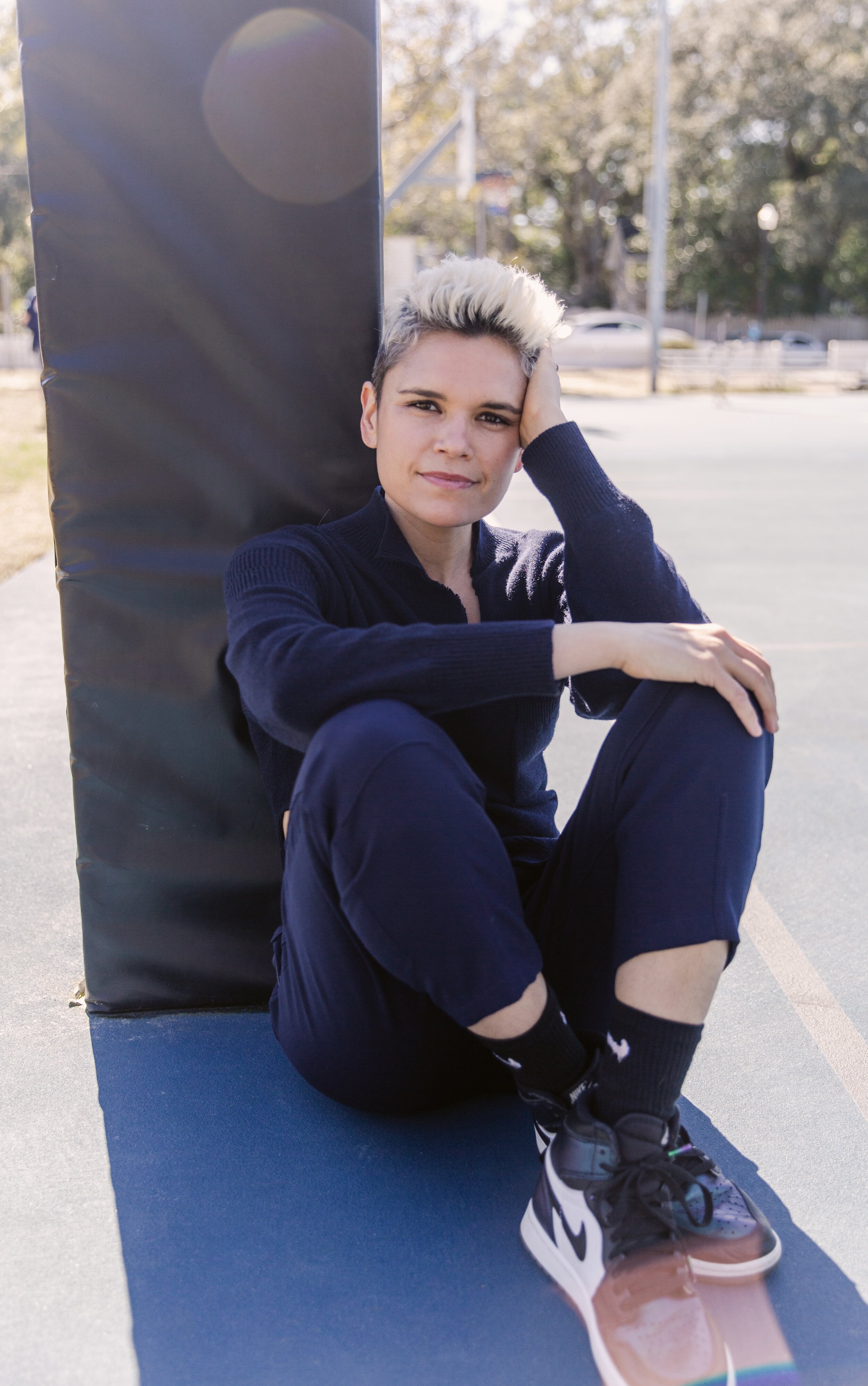
What Brittney Griner Says About Us

This article can be found on espnW.  (And Interview with Sage Steele on SportsCenter.)

By Kate Fagan

Over the past four years, a certain segment of “fans” in this country have played a silly little game called, unofficially, “What We Say About Brittney Griner.”

The way it works is simple. No matter what Griner does — win the NCAA championship with Baylor, earn national player of the year honors, break her wrist skateboarding, drop 50 points on Kansas State — the naysayers hop on message boards and social media to deliver a variety of insults, questioning her fierce on-court demeanor, her talent in comparison to male players, even her genetic makeup.

Rather than embracing Griner as a gift from the basketball gods, a player years ahead of her time, they have turned her into a 6-foot-8 lightning rod for all of their complaints and fears about the women’s game.

And over the next few weeks, as Griner tries to cap her record-setting college career by winning a second straight national title, it’s a pretty good bet that whatever praise she receives will also come with a side dish of scorn — because her best seems to bring out some people’s worst.

Truth is, those ugly things they say about Brittney Griner aren’t really about her.

They’re about us.


We live in a world that embraces innovation because it stretches our understanding of human possibility. Anything that gives us a glimpse of the future — yesterday the iPhone, today Google Glass — inspires child-like wonder, including the exploits of superstar athletes.

Consider former NBA center Shaquille O’Neal, who burst onto the scene in the 1990s, a physical specimen the likes of which we had never seen on a basketball court. Shaq was different, and we celebrated him for it. Fans posed for pictures holding his size-23 sneakers, gawking at the oversized Reeboks as if the shoes had just arrived via time machine. He was 7-foot-1 and 325 pounds, and he was nearly unstoppable (except at the free throw line).

Shaq’s presence in the low post forced defenders to take risks. Some opponents doubled him, daring his teammates to score. Other squads employed the “Let him beat us” philosophy, putting one defender on Shaq and locking down on everyone else. And when the game was on the line in the fourth quarter, most teams tried the Hack-A-Shaq strategy, rolling the dice by sending him to the foul line, where he shot just 52.7 percent for his career.

Like Shaq, Griner makes opponents uncomfortable because they can’t do things the way they normally would in practice. She keeps coaches awake at night, worrying about how disruptive she is on both ends of the floor. She can turn and score over either shoulder — sometimes by dunking the ball — and on defense she eats up space with her 88-inch wingspan. She is the second-leading women’s scorer in Division I women’s history, with 3,203 points, and the all-time leader in blocks, with 736.

“Because of her skills and her unique abilities, Griner has added a dimension to the game that hasn’t existed up to this point,” UConn coach Geno Auriemma said during last year’s Final Four.

But whereas Shaq was hailed for being big, bold, different, Griner is sometimes viewed in a harsher light, with skepticism bordering on suspicion. When people called Shaq a freak of nature, it was a compliment; when directed at Griner, the term often carries a cruel edge, punctuated with the refrain of “She’s a dude!”

Such wary appraisals are not unique to Griner, of course. This is what Joe Fan does to any female athlete who doesn’t fit neatly into one of two boxes: the cool, tough-talking guy’s gal (see: Ronda Rousey, Lindsey Vonn) or the unattainable beauty (see: Maria Sharapova, Anna Kournikova).

The sport of tennis has witnessed what happens when a dominant woman eludes traditional labels. Martina Navratilova endured derisive comments during her career, first for being too pudgy and then too muscular. Similarly, former world No. 1 Amelie Mauresmo, who won two Grand Slam titles in 2006, drew attention for a perceived lack of femininity, with Martina Hingis infamously calling her “half a man.” Even Serena Williams, who embraces her curvy body with bold outfits, has routinely been portrayed as menacing because of her powerful arms and ultra competitive nature.

As Griner and Baylor have become more dominant — the Lady Bears are currently 32-1 after finishing 40-0 last season — the storylines around their games have taken on a David-and-Goliath quality, as if the odds are so tilted in Baylor’s favor that everyone else has a built-in excuse for losing. They have Brittney, and we don’t.

But largely unacknowledged is the fact that Griner has taken one on the chin for the entire women’s game.

Before she arrived on the scene, critics of women’s basketball generally argued that it wasn’t feminine enough and the quality of play not high enough to hold the attention of mainstream sports fans. During her college career, though, Griner has absorbed the bulk of the disdain previously shouldered by thousands of players. She has brought athleticism to the women’s game in a package we’ve never seen, and yet the chatter around her — the narrative in barrooms and on message boards — is she’s still an inferior athlete when compared to a man like LeBron James.

Apparently, it’s very important for some fans to point out that King James, or any other NBA player, would smoke Griner in a game of 1-on-1.

“We disparage female athletes so we don’t have to make room for them,” says Nicole LaVoi, a professor at the University of Minnesota and the associate director of the Tucker Center for Research on Girls & Women in Sports. “People can’t just say, ‘Wow, Brittney Griner is a great athlete.’ We need to have a caveat: ‘She plays like a guy, she looks like a guy, she must be a guy.’ These qualifiers marginalize what Brittney has done and serve to keep the current pecking order in place, whereby men’s sports are more valued, more culturally relevant — the norm.”


Detractors of women’s basketball often say some variation of the following: “Wake me up when women can dunk.” The implication is that people would pay more attention if the athletic exploits of women more closely resembled those of men.

Griner has exposed this sentiment – If you dunk, we will watch – for what it is: empty words, hollow as the ball itself. She has dunked 14 times in her college career (including seven this season), and throws down regularly in pregame warm-ups, offering fans the potential of seeing something awesome. She slams one-handed, two-handed, on the break, in traffic. And yet none of this seems to be the kind of dunking that Joe Fan wants to watch. On the contrary, Griner’s dunking is frequently dismissed by people who argue that anyone 6-foot-8 should easily be able to rock the rim.

Most of these people have never dunked, of course.

More to the point, how is women’s basketball supposed to evolve, to become more athletic, if the bodies of the athletes playing the game don’t become, well … more athletic? It’s basic physiology. In order for a woman to jump higher and run faster, she must have higher muscle mass and lower body fat, both traits traditionally deemed masculine.

So, to recap: Women’s basketball is maligned for not being as athletic as the men’s game, but as women become more athletic, these players are often labeled unfeminine, and therefore unwatchable.

Feel free to pause here and scratch your head.

Essentially, the women’s game is in a Catch-22, because what these critics seemingly want is to watch female ballers who can athletically rival the men — but in the bodies of swimsuit models. In other words, the nonbelievers will never watch women’s hoops because they are waiting for a version of the game that, biologically speaking, will never exist.

“In our society, women are expected to stay in a certain kind of role, and Brittney Griner doesn’t,” says Don McPherson, a former NFL quarterback who now runs social outreach programs aimed at breaking down gender roles. “So because she doesn’t fit any of our labels, we get scared, and we tear her down.”


Everything shifted after The Punch.

On March 3, 2010, in the second half of Baylor’s game against Texas Tech, Griner was ejected for clotheslining forward Jordan Barncastle, with whom she had been tangling on the block. Griner was then suspended for two games, one courtesy of the NCAA, the second tacked on by Baylor coach Kim Mulkey.

Griner was already a genetic outlier, inches taller than the next-tallest player, capable of athletic feats that set her apart. But after The Punch, cynics began making comments that showed they believed Griner was also a social outlier, someone to be feared.

A peculiar thing happens when people watch women’s sports — to fans and media alike. Even though we’re viewing these athletes in a space we’ve all agreed is designated for competition (in this case, the basketball court), we still expect them to represent traditional gender roles. And we are less forgiving when they cross the line.

Our female athletes are packaged in a way that reassures us: She is nice, caring, sweet. If the on-court action doesn’t reflect this ideal — if the players get testy — writers and TV announcers often fill in the gap: Wow! Things got pretty heated around the basket there. But you know what? That Brittney Griner is a big softie off the court, just so kind-hearted.

“Brittney challenges the idea of who we believe should be dominating sports, which ignites some sort of fear in people,” says Nefertiti Walker, an assistant professor in the sports management department at UMass Amherst, and also a former basketball player at Georgia Tech and Stetson University. “Why can’t we just let her be a tough basketball player? It’s because we haven’t moved past gender stereotypes. So we end up apologizing whenever Brittney, or any female athlete, does something on the court that isn’t ‘nice.’ But why do we need our female athletes to be nice on the court?”

This incongruity can be difficult for players to navigate, and Griner is no exception. Behind the scenes, she is carefree, funny and easy to talk with, often putting an arm around someone’s shoulder to show she’s giving her full attention. But when Griner walks into the media room, sits behind the microphone and answers questions, she appears to be on autopilot: BG Lite, a muted version of the real thing.

And who can blame her, or Baylor, for treading lightly? (The program declined an interview request for this column.) Most college coaches in Mulkey’s position would rather build a cocoon around their star player than take the risk that more exposure might lead to more ridicule.

Following Baylor’s win over UConn on Feb. 18, Griner was walking with teammate Odyssey Sims from the locker room to the postgame interview room. The pair shuffled along the cement floor of Hartford’s XL Center, with Griner stepping cautiously because she hadn’t bothered to fully press her heels into her size-17 Nikes. Sims and a member of Baylor’s support staff were asking Griner about her clear complexion. How do you keep your skin so smooth? Griner credited her genes, then pointed out that she had never worn makeup.

Sims cocked her head, a sly grin creeping onto her lips as she said to her teammate, “Whatcha mean you’ve never worn makeup? What about that time up at ESPN?”

The point guard was talking about a photo shoot that Griner had done for an early-season storythat also featured Notre Dame’s Skylar Diggins and Delaware’s Elena Delle Donne. In the opening montage, the three stars are all casually posed in the basketball equivalent of a glam shot: in uniform, holding a ball, looking as fresh as the last player on the bench.

Griner smiled at Sims and rolled her eyes. “I meant I never wore makeup growing up,” she said, flashing an expression that looked a lot like the equivalent of C’mon, everybody knows how photo shoots work.

Watch her up close, interacting with teammates or fans, and you can see Brittney Griner is comfortable in her own skin.

So why can’t more people be comfortable with her?


After Baylor beat UConn, ESPN analyst Rebecca Lobo sent the following Tweet: “I hope women’s basketball fans understand how special Brittney Griner is. Only six more weeks to watch her as a collegian.”

Now we’re down to three weeks at most, if Baylor advances to the Final Four. Soon Griner will transition to life as a professional athlete, free to market herself however she sees fit. She will almost certainly be the first player selected in the WNBA draft in April, and if she ends up playing alongside Diana Taurasi in Phoenix (the Mercury own the top pick), the duo could be a lot of fun to watch.

But how much will it matter? The spotlight shines brighter on the women’s college game than on the WNBA, not least because female pro ballers spend most of their time playing overseas. Only a handful of stars — Taurasi, Candace Parker, Maya Moore — seem as popular now as they did in college, and rarely are they part of the broader sports conversation, most notably during the Summer Olympics.

So as we watch Griner’s final games in a Baylor uniform, it makes sense to look back and examine the conversation around her, because what lies ahead is anybody’s guess.

Can Griner raise the WNBA’s profile and build on her own brand? And are sports fans ready for a 6-foot-8, skateboard-riding, Vans-wearing pitchwoman — big, bold,different, like Shaq — who can sell us sneakers, energy drinks and watches?

When Jodie Foster received a lifetime achievement award at the Golden Globes in January, fellow actress Kate Bosworth shared an old Foster quote via Twitter: “Normal is not something to aspire to; it’s something to get away from.” Almost immediately, those words were recirculated by thousands in a kind of collective “Amen, sister.”

Because if there’s anything we can all agree on, it’s to celebrate our differences. Right?

We have seen the future of women’s sports, and athletes like Brittney Griner are leading the way. Strong, muscular, fierce, unyielding — less willing to be packaged in the same old-fashioned manner.

There will be more players like Griner. Maybe not tomorrow or even next year, but eventually they will come. When they do, maybe sports fans will be more ready for them, and the verbal darts that have flown these past four years will look like rusty relics, a weapon of the uninformed.

Griner has surely learned that most uncut paths are lined with thorns.

What have the rest of us learned?

Recent events expose sexism in sports culture

This article appears on espnW.com.

During my first year covering the 76ers for The Philadelphia Inquirer, I walked into the locker room after an early-season game. One of the team’s best players had already made a habit of conducting his postgame interview immediately after exiting the shower. Sometimes he spoke with just a towel wrapped around his waist, another one draped over his shoulders.

On this particular night, I made eye contact with him as he sat on his chair, still wet from the shower. Thinking he wanted to get his media obligation out of the way, I walked toward him. His words stopped me. “You like walking up on half-naked men?” A sly smile crossed his lips.

I stammered a few words — I think I was actually trying to apologize — as my heart began hammering. I turned and left the locker room, leaning against the wall a few steps from the door. Arena staff and team personnel streamed past. I kept my head down and tried to regain my composure. I remember looking at my notepad, opened to an empty page that I still needed to fill, wondering if I could do this job.

A minute later, I walked back into the locker room. The player was talking to the other beat writers, all of them men.

He was still wearing only a towel.


I’ve been thinking about that interaction a lot lately, my memory triggered by a slew of recent events that expose, to varying degrees, the unrelenting sexism that exists in our sports culture. Sometimes it’s blatant; more often than not it’s subtle, a never-ending reassertion of power intended to keep men in control and women on guard.

Consider the words of Sacramento Kings center DeMarcus Cousins, who was ejected from a game on Feb. 5 for telling a referee to stop “acting like a f—ing female.”

It’s hard to say what’s more disconcerting: the casual contempt in Cousins’ words or the fact that most writers chose to ignore it, focusing instead on his use of the F-bomb (that is, his cursing) and his reputation for questionable on-court behavior, which has led to 11 technical fouls this season.

Yahoo’s Dan Devine, to his credit, acknowledged that calling someone a female “shouldn’t be an insult.” And Cousins himself said afterward, “I shouldn’t have said that.” But the fact remains that the quickest way to cut a man down in sports is to call him a woman.

My three seasons covering the Sixers were filled almost entirely with respectful, professional interactions. And I’m happy to say that Philly’s notoriously hard-to-please fans were great. Even so, there were some eye-opening moments (more on those later), little jabs here and there, the kind that add up over time.

Most women in this profession have stories like mine, some of them a lot worse than mine.

During the recent NFL playoffs, a female colleague wrote a column that sent thousands of fans over the digital edge because she said, rather matter-of-factly, that their team had little chance of winning. She was quickly bombarded with threatening, degrading, misogynistic messages, the sort of stuff that made “Go back to the kitchen” (one of the taunts) seem tame in comparison.

This kind of “dialogue” has become commonplace across Internet message boards, where comments about female athletes and writers — posted by anonymous readers using objectifying terms or spitting vitriol to their hearts’ delight — amount to a form of uninterrupted sexual harassment. (Here at espnW.com, our comments are under a Facebook plug-in, ensuring that people have to put their real names, presumably, on what they post.)

Some people might shrug and say this type of gender-bashing is bound to happen in a male-dominated environment. But, of course, we know there’s more to it than that: It’s a microcosm of how women are too often disregarded across society.

And the repercussions are all around us at the moment, as women and men try to make sense of the recent hailstorm of “sports” stories that have nothing to do with what happens on the field: the Jovan Belcher murder-suicide tragedy in Kansas City; the alleged sexual assault of a teenage girl in Steubenville, Ohio; the suspension of Tufts lacrosse players for sexist taunts.

Belcher murdered his girlfriend, killed himself and left their infant daughter orphaned — yet the ensuing media coverage mainly focused on a young, hardworking football player gone too soon, a storyline apparently easier to tackle than a national epidemic of violence against women. Two high school football players in Ohio allegedly assaulted a young woman, then others reveled in it on social media – yet little came of the incident, or the initial New York Times report of it, until an online vigilante group helped balance the scales of power and led the call for justice in Steubenville.

A few weeks ago, 27 Tufts lacrosse players were suspended for shouting sexist and racist comments during an on-campus women’s volleyball match in September. The men, some of them drunk, directed most of their heckling at the players and coaches from Smith College, an all-women’s school.

Tufts student Rose Barrett was in the stands that day, and she published an opinion piece in the student newspaper detailing the harassment. “We need to think about why no one stood up to them at that time,” she wrote, “and what sort of culture we create that makes this sort of behavior acceptable.”

Yes, we do. Because the social construct of what it means to be a man too frequently comes at the expense of women.

“It’s all a front,” says Don McPherson, a former NFL quarterback who now runs social outreach programs aimed at breaking down gender roles. “Masculinity is an act. It’s about being strong, tough, not crying, and, above all, never betraying the code of masculinity. Part of the conversation that still has not happened is around the construct of gender. Men inflict violence on others. Men are the ones doing this. Are we ready to have a conversation about that common link? I don’t think we are. What gets us there? Quite frankly, I don’t know. The vast majority of men are not abusers; the vast majority are good guys. But the vast majority of men are silent.”

And that’s the problem here: the silence of the good guys. In those blurry pictures taken that terrible night in Steubenville, we see two young men dragging a young woman who was reportedly unconscious. But we don’t see the other young men (and women) standing in the background — likely silent, immobilized, afraid of “betraying the code.”

Too often, the silence becomes white noise, as everyone fixates on some smaller issue rather than the thing itself. They hotly debate why the Kansas City Chiefs would go ahead and play a game just one day after Belcher shot Kasandra Perkins nine times before taking his own life, but they pay only lip service to domestic violence and its root causes. They wonder whether Steubenville’s obsession with high school football, and the team’s success, blinded the locals to what’s right and wrong — as if Steubenville is somehow different, the sad exception, when in reality there are a thousand towns just like it across the country.

It’s so much easier to wash our hands of an unsavory event if we convince ourselves that the behavior in question was created by an unusual set of circumstances. Blaming football, as McPherson points out, is an easy way to let everyone else off the hook, instead of grappling with a much larger, far more complex set of issues. Because sports don’t exist in a vacuum.


Covering the Sixers wasn’t my first time dealing with big-time male athletes. I had played on a basketball scholarship at the University of Colorado, followed by three seasons of pro ball, so I was hardly a naive newcomer when I arrived in Philly — at least not when it came to athletes’ egos.

During my second year on the job, a player pulled me aside and told me I would be blacklisted for a week or so because I had called out one of the guys in a column. The team, he explained, would be forced to uphold the “bonds of brotherhood.” All beat writers are stonewalled by The Brotherhood at some point during their career, and some aren’t fortunate enough to receive advance warning. To this day, though, I remain skeptical of most brotherhoods, including those in sports journalism — which you can see in full force every day in social media — because they serve only to deliver power to power.

Toward the end of my tenure covering the Sixers, someone higher up in the organization took particular offense to something I had written and sent me the following text: “You are a conniving/deceitful woman! Sleep well, Kate.”

I didn’t sleep well that night, nor for a few nights afterward. But I’ve kept that text in my phone and look at it occasionally to remind myself of the uphill battle all women face. For the record, I would have been perfectly fine being called an old-fashioned a–hole for what I’d written. I was a beat writer, after all; criticism comes with the territory. But I didn’t go around introducing myself as a “female beat writer,” and I certainly didn’t appreciate the suggestion that my gender — my “conniving/deceitful” gender — had somehow clouded my assessment of a struggling team.

Yes, male athletes and writers have all sorts of insults slung at them, too. The difference is their gender rarely enters the equation. And while it’s easy to dismiss the online trolls — whose comments rely upon other people breathing life into them — the truth is that the hostility on message boards is a virtual representation of the hostility a lot of women face every day.

Houston Rockets rookie Royce White recently offered a thoughtful take on the increasingly frightening nature of message boards and social media.

“As much as we want to think that these are just people behind computer screens, those people are living next door to you,” White said. “They are people behind computer screens in schools. In hospitals. Working in Washington, D.C. These are real people. How many times does this stuff have to happen before we admit something really disturbing is going on here? I think one person tweeting ‘F— you, go kill yourself’ is disturbing. But when you get into the hundreds of those tweets? The thousands of those tweets?”

The most surprising thing is not that incidents like Steubenville happen; it’s that not enough people seem willing to stand up and address the underlying issues.

The warning signs are all around us.

And they are not subtle.

Why Brendon Ayanbadejo Can’t Celebrate — Yet

This article appears on espnW.com.

Image

By Kate Fagan

NEW ORLEANS — Brendon Ayanbadejo is king of the world — for a few minutes, anyway.

The 36-year-old linebacker has just won the Super Bowl with the Baltimore Ravens. The confetti is still swirling, the cameras still rolling, and the Lombardi Trophy has just started its first lap of the Mercedes-Benz Superdome, carried aloft by a few high-on-life Ravens, who are pausing every few yards to show it to a new section of giddy fans.

In the midst of all this, Ayanbadejo is standing quietly but happily with his longtime partner, Natalee Uzcategui, and their two children, six-year-old daughter, Anaya, and 22-month-old son, Amadeus Prime, both of whom are wearing pint-sized versions of Daddy’s No. 51 purple jersey. Ayanbadejo is wearing a single strand of silver beads, given to him by “The Ellen DeGeneres Show” because of his tireless advocacy for marriage equality. Natalee is holding their son, balancing him on her left hip as he sucks on a football-shaped pacifier, when a camera crew approaches and asks Ayanbadejo for an interview.

He holds his daughter’s hand as he answers all of the questions, including the one about how sometime this spring Amadeus Prime will likely have surgery to correct a congenital heart condition. Ayanbadejo answers this one instinctually, kind of similar to how he reacts on the field, explaining that he won’t be able to fully celebrate this Super Bowl until his son is fully healthy.

Anaya drops her father’s hand and turns to her mother. The girl looks crestfallen, confused, and her eyes ask a question that — right now, right here in this bright moment — Natalee isn’t sure how to answer. So she gently pulls her daughter to her side and shoots Brendon a look that says,What do we do now?

“I’m so sorry,” Ayanbadejo says when he has finished the interview. He puts his hand on Ayana’s shoulder, brings Natalee near, and gestures to the small circle they’ve created. “This is our whole world, right here,” he says to his family. “See us? Nothing in this life is promised; tomorrow is never promised to us. But being here right now is special. It’s one of the greatest things ever.”

Brendon and Natalee had agreed to wait until after the Super Bowl to tell Anaya about her brother’s health condition. She is strong-willed, just like her father, so they wanted to sit her down and explain what was happening, let her ask all of her questions. They did not, of course, intend for her to find out while standing in the middle of a Super Bowl celebration, late at night, already on sensory overload.

“I just made a mistake,” Ayanbadejo says later, shaking his head. “I didn’t even think about it. That’s an emotional thing for her to hear. She wants to protect her baby brother because she’s the big sister.”

Anaya wants more information, but that’s impossible right now. She keeps looking up at her mother as her father does a few more on-camera interviews. Each time the camera swoops in front of him, Brendon gives Natalee a helpless look. At one point, Olympic champion swimmer Michael Phelps, a Baltimore native, walks up, wraps Ayanbadejo in a hug and whispers into his friend’s ear, “That was so sick — so sick.”

Finally, Ayanbadejo starts walking with his family toward the tunnel. But then there is another interview ask, then autograph requests, then picture requests. At first, Ayanbadejo stops for everyone, smiling big on cue. In between the interactions, though, he looks preoccupied. So he starts saying no: “I can’t, man. I’m sorry. I’m just trying to be with my family for a second.”

They reach the tunnel that leads to the locker room, but only Daddy can enter. He tells them all he loves them, as Natalee says, “I’ll text you to figure out where we can meet.” He nods, and then he is gone.

Natalee makes her way to a different exit. She has switched Amadeus Prime to her right hip; he seems content, absorbing his surroundings with ocean blue eyes. Anaya, hair bouncing, runs alongside her mom and clasps her left hand. They walk off the turf and into the concrete hallways of the Superdome.

The questions begin immediately.

“Why wouldn’t you tell me?” Anaya asks.

“We just wanted to wait until after the game,” Natalee says. “We met with some doctors in Baltimore. They’re the best in the world, OK?”

“But why wouldn’t you tell me? I’m his sister!”

“Daddy didn’t mean to,” Natalee says. “He didn’t realize. He just made a mistake.”

And right before that, he won the Super Bowl.

Tagged , , ,

From Russia With Topspin

This article first appeared on espnw.com.

MOSCOW, Russia — A young girl stands on an indoor tennis court, bouncing from one foot to the other, like a boxer in the ring before a fight.

She stares straight ahead, eyes furrowed at the corners. Her brown hair is pulled tightly back, not a strand out of place. Her right arm dangles, her hand gripped tightly around a racket almost half her size. A second later, she whips the Babolat from back to front, watching the flight of an imaginary ball rocketing toward the far corner of the court. Her feet still bouncing, she turns her hips and attacks the next invisible globe with a backhand just as fierce. After a few more practice swings, she stops and nods to herself.

She is ready.

Outside, clouds are hiding the sun, and the temperature is dropping by the hour. A cold front is moving in, one considered harsh even for December in Moscow. The day is dark, the air uninviting, as the wind whips against the walls of the Spartak Tennis Club.

Kseniya Alyeshina, who will soon celebrate her 10th birthday, is one of Russia’s top-ranked players in her age group. Her coach, Andrey Matrosov, stands on the opposite baseline next to a bucket of yellow balls. They are practicing on one of three courts beneath Spartak’s white domed roof. The poured concrete playing surface, coated in plastic, is uneven in areas, especially near the corners.

This whole place has been untouched since it was built in 1979, except for one thing: the color of the courts. During a visit to Spartak in the early ’80s, a high-ranking Soviet official found the original gray hue so drab that he spent $25,000 of the state’s money to paint the surface green. He was subsequently reprimanded for failing to obtain the proper authorization papers. (As the saying goes in Russia, you need official papers to prove you are even alive.)

Despite the humble surroundings — the scuffed posts, flimsy wooden doors and rusted lockers — dozens of world-class tennis players first learned the game here. Anna Kournikova, Marat Safin, Dinara Safina, Elena Dementieva, Yevgeny Kafelnikov and Anastasia Myskina are the most familiar names. But there are others who have made their mark, including current pros Nadia Petrova, Vera Zvonareva, Mikhail Youzhny, Dmitry Tursunov and Igor Andreev.

The number of players who have come through Spartak would seem to suggest it’s a tennis outlier, the kind of place that raises some interesting questions about how talent is developed. Imagine a town in which there is just one, well-worn piano, yet that town produces a surprising number of the world’s finest composers. Does waiting in line to make music on scratched ivory produce something special inside the student? Or is there something special inside the student that compels her to wait in line to play that piano? When a place seems immune to the standard rules of talent distribution, our curiosity is piqued. Is there some universal truth to be found here?

What’s in the water?

And in the case of Spartak, we can zoom in even closer to examine the success of its female players because the academy’s influence is felt most strongly on the women’s side of the game. Over the past 15 years, the program has produced a steady stream of female pros. The 2004 French Open women’s final, where Myskina beat Dementieva, was an all-Spartak affair. And ever since Kournikova broke into the top 15 in 1998, there has been a Spartak alum near the top of the women’s rankings. Today, Petrova carries the torch; she is ranked No. 12 in the world heading into the Australian Open. The 2013 season also could provide a glimpse into the next Spartak infusion, as juniors Yulia Putintseva and Irina Khromacheva look poised to compete at a higher level.

But this wouldn’t be a Russian story without struggle. Most of the aforementioned players felt compelled to leave their home country by age 14, sometimes earlier. They spend their formative years inside the cocoon Spartak provides, but eventually they realize the facilities are too dated and the cost of training in post-Soviet Moscow too steep. So they must leave the place they’ve come to know and switch to an academy abroad. Some, such as Putintseva, even go as far as to change their nationality.

The dynamic is complicated, to say the least. Still, it is at Spartak where these players first learn the game and dream of where it might take them. A palpable optimism fills the air here. Walk through the guarded gates, past the whitewashed statue of Lenin and inside the complex that houses Moscow’s only indoor tennis courts — where some of the world’s best coaches and most motivated young players devote themselves to the sport — and one thing becomes clear above all else.

Here beats the heart of Russian tennis.

Creativity born of necessity

Matrosov grabs a yellow ball from his bucket and holds it high in front of him, swiveling it to give Alyeshina a full view, as if later she will be called upon to identify this particular one. He turns and walks to the back right corner, placing the ball into the final space still considered in bounds.

They have exchanged no words, but Alyeshina understands what her coach wants; they’ve been working together for more than five years. Matrosov drop-serves a ball over the net. Alyeshina shuffles into place and meets the bounce with precision, her forehand return creating a flash of yellow as the ball whizzes back over the net on a line as straight as the pleats on her white skirt. It lands just a few inches from where Matrosov placed the target — so close, in fact, it appears as if hitting the space nearest to the ball, rather than the ball itself, was the girl’s true intention.

Behind her, a balcony stretches the length of the three baselines, offering a few rows of wooden seats with worn red cushioning, a vestige of Spartak’s original incarnation as a handball venue in the 1980 Summer Olympics. Alyeshina’s mother stands on this perch, overlooking the first court. She is wrapped in a full-length fur coat — it is 10 degrees outside — and grips the banister as she watches the lesson below. “That is my daughter,” she says with a proud smile.

Twice a year, in May and November, Spartak holds tryouts for kids ages 5 and 6. A spot in the academy is in such high demand that some parents have discovered in advance what exercises the children will be asked to perform, then drilled their kids for months. No matter, says Spartak head coach Igor Volkov, one of the program’s 12 coaches, all of whom can spot the difference between a prepared child, trained in advance by a parent, and a gifted youngster who possesses innate skills that will translate to tennis. “We know if a child is capable of this game,” Volkov says through an interpreter. “And we will keep only the best.”

Volkov has run Spartak since the government opened the club’s outdoor courts in 1971. Many sports academies popped up during that time, as part of the USSR’s investment in Olympic domination, what became known around the globe as “the Russian sports machine.” And although much has changed politically in the past four decades, Spartak’s basic funding structure remains in place.

More than 100 children try out for the club each season; one in four is selected. At the end of each year, more testing is done, and only those students who have progressed sufficiently are allowed to continue in the program. To demonstrate how this works, Volkov tents his fingers, touching his thumbs and forefingers to create the outline of a pyramid. At the base of the pyramid are the children selected at semiannual tryouts, a cross-section of young talent from which only the best are funneled upward to the next level. “We are concerned only with raising the champions,” Volkov says, pointing to the tip of the pyramid.

That’s not to say money doesn’t play a crucial role at Spartak, especially for children who come from families with modest means (more on that later), but the financial support provided by the government has allowed the academy to preserve its selection formula, welcoming talented kids regardless of class. Many of the surrounding tennis schools, on the other hand, must cater solely to the wealthy as a matter of basic survival.

At times, the way Volkov talks about producing champions makes Spartak sound like a Cold War cliché, a factory assembly line of children glumly holding tennis rackets. But to watch him in action, gregariously greeting students and offering encouragement, is to see the essence of Spartak. Although the school is proud to have retained some Soviet-era philosophies, most of the current coaches take a more Western approach to teaching. These men and women have traveled the world, often as players on tour, and they blend the best methods they’ve picked up along the way.

Despite monumental changes in Russia in the past 20 years, some things retain a familiar feel. On our first day at Spartak — photographer, interpreter and reporter — we breeze right through the front gate; at the beginning of Day 2, however, we are stopped by an armed security guard, who ushers us into the office of the security chief, then stands in the doorway, arms crossed. The problem is made clear after a few minutes of rapid-fire exchange: Someone must “make official paper.” So the interpreter sits at a table, pen in hand, scribbling on a piece of blank white paper provided by the guard. It is the least official-looking official paper, a swirl of blue ink covering both sides, but the security chief nods his satisfaction.

The guard mostly seems pleased to have something to do, which is understandable, as this part of Moscow draws few visitors. Spartak is tucked in the woods on the edge of Sokolniki Park, which sits on the city’s outer ring. The closest metro stop is a 40-minute walk, along a route packed with snow, covered by a layer of frozen ice and populated with stray dogs. Driving won’t get you anywhere in Russia’s capital, not quickly anyway, because the highways haven’t expanded to match the number of cars Muscovites have purchased in the past two decades. In Moscow, home to 12 million people, sitting in a car and staring at brake lights is better than the way things used to be — no car at all and a 10-year waiting list just for the opportunity to purchase one.

Beyond the security chief’s office is a long stretch of hallway, then a pingpong table, then a small set of stairs that open onto court level. Stories about Spartak in the Soviet days focused on the formula for making stars — the tekhnika (technique) and the imitatsiya (imitation) — and the blanket rules for all children, who were not allowed to play matches until they had trained for three years. The academy still prides itself on teaching crisp fundamentals, but the coaches here adopted a philosophy of individualism many years ago, tailoring their teaching to the strengths and weaknesses of each player.

“We have combined the thinking,” Matrosov says through an interpreter. “During the USSR period, during the late 1980s especially, things here were more rigid, more uniform. But it’s evolved, and even before the disappearance of the Soviet Union, we were already starting to use individualized coaching.”

The best male player training at Spartak this winter is 12-year-old Alexey Zakharov, ranked No. 1 in Russia for his age. His light brown hair occasionally flops in his eyes, and he is dressed from head to toe in Nike gear. He says his goal is to become an Olympic champion for Russia, to make his country proud. His forehand and footwork are without flaw.

Melissa Ifidzhen, a 14-year-old with a 110 mph serve, makes a strong case for top honors among the girls. She trains at Spartak six days a week, resting only on Sundays. She does not attend school, instead studying with the help of her parents (her father is from Congo, her mother from Ukraine) and taking her exams on the Internet. “I play because I love the competition,” says Ifidzhen, whose easy smile belies her fierce game. “There are pictures of the stars who learned here — they are everywhere — and once we see them, we want to become stars, too.”

Tennis is a full-time job for some kids, who must overcome the weather and shortage of courts. For seven to eight months a year, the 150 kids enrolled at Spartak are moved from the 21 outdoor clay courts into the cramped indoor facilities. (In addition to the main building, there is another indoor court on the grounds, equally worn and dated.) But although Moscow is at a disadvantage because of its climate, it’s also true that creativity is born of necessity — and this is where Spartak shines.

“See Alexey over there?” asks Matrosov, pointing to Zakharov, who hits a backhand winner, then pumps his fist. “In America, there might be five courts and three kids. Alexey would be alone. Here, we have five kids on one court and we must close at 6 p.m. Nobody will waste a minute. What are we to do in this circumstance but adapt?”

Three boys and two girls are playing a game they call “The Chesnok.” About five years ago, former Spartak student and tennis pro Andrey Chesnokov showed this drill to the kids, and they named it after him. (In Russian, “Chesnok” translates to “garlic,” which also makes them laugh.) The drill is continuous and competitive. Two kids play a point. The winner holds the court, and the loser rotates off. If a player takes two points in a row, he or she moves to, or stays on, the “winning side” — the one with only two players and less of a wait.

The kids are enthralled, dripping sweat and clearly testing shots they’ve not quite mastered. One girl tries a tricky backhand down the line, but the ball sails way out of bounds. Matrosov calls out an adjustment, telling her to bring her racket through more level. A few minutes later, she tries the same shot and scorches it for a winner. A smile dances at the corner of her lips, but she quickly shakes it away and serves to the next opponent.

“This is what makes Spartak great,” Matrosov says.

When Dementieva and Myskina (now both retired) were at Spartak in the early 1990s, they would play each other for pizza. “Spartak is an ordinary club like many others, but the thing we had was a lot of players with talent, desperate to play,” says Dementieva, who won an Olympic gold medal in singles at the 2008 Beijing Games. “Competition is the best motivation and inspiration for development. That is something money can’t buy.”

And more often than not, young girls and boys train together on these indoor courts. The same afternoon that Matrosov’s students are playing their game of “The Chesnok,” another Spartak coach, Evgenia Kulikovskaya, oversees a session of doubles being waged by three girls and one boy, ages 13 or 14. Kulikovskaya, 34, is a former top-100 player and was the protégé of Russian coaching legend Larisa Preobrazhenskaya, who was highly regarded in the tennis world as a stalwart of Spartak’s Soviet-era dedication to good, old-fashioned tekhnika.

Preobrazhenskaya died three years ago, but her influence is still felt. She coached the young Kournikova, who spent five years at Spartak before moving to Florida in 1991 to train at the Bollettieri tennis academy as the Soviet Union was collapsing. And it was Preobrazhenskaya who allowed Kournikova’s mother, Alla, to attend practices, which led to other mothers following suit.

During today’s session, three mothers are watching their children play doubles. One of them sits courtside in a white fur coat, splitting her focus between an iPhone and the action. Her daughter, a talented left-handed player, looks over between each point, hoping for reassurance but expecting criticism. Finally, after several exchanges between them, the girl rolls her eyes and says something, the tone of which is universal. “Mom! Stop!”

When Kulikovskaya took over Preobrazhenskaya’s duties, she couldn’t easily say to these parents, “No, you can’t come anymore,” even though she realized the potential for distraction. “Everyone who comes here thinks her daughter will become the next Anna Kournikova,” she says.

A confluence of factors contributes to Spartak’s success in churning out female tennis talent — some cultural, some practical. Although Russian boys have other major sports competing for their attention, namely hockey and soccer, girls have fewer options. Figure skating and gymnastics, disciplines in which the Russians have long excelled, require certain body types and offer shorter, less profitable careers. So when Spartak holds its semiannual tryouts, the talent pool for girls is generally deeper.

“I also think it’s about motivation,” Kulikovskaya says. “I think there are not as many chances for girls. Our universities are not highly ranked in the world, and even if you have a good degree, it doesn’t mean you will have a good job here. You also have to know people. So the girls fight for a chance at a good life, for a better life.”

And at Spartak, the girls actually have an advantage. Because of limited court space during the long winters, girls are sparring against top-level boys for two-thirds of the year. “If a girl practices with a boy, she is already playing at a higher level,” Kulikovskaya says. On the court right now, the boy serves with speed and power during the doubles match. The team of two girls struggles at first to return his serve, but soon they pick up on the pace and begin figuring out how to get the ball back over the net.

“The boy hits harder than the girl,” the coach says. “Here, it’s just harder for the boy to continually get better.”

Steep price to pay

An Audi, a Lexus and a BMW are parked in one of Spartak’s lots. An Acura approaches the gate and unloads three kids, all of whom sling Babolat bags over their shoulders. The promised cold front has arrived, but so has the sun, which is reflecting brightly off the hood ornaments, making these new-model cars impossible to ignore. As a black Range Rover passes, our interpreter says, “Do you see this? This is Moscow; this is not Russia.”

What she means is that Spartak has changed. Although the collapse of the Soviet Union ushered in democracy, capitalism and more individual freedoms for Russian citizens, it also uprooted the social infrastructure, which included state-sponsored training. The impact of those changes was tempered for a time by the tennis boom spurred by former president Boris Yeltsin, whose love of the sport increased its popularity and, by extension, the funding it received. (Yeltsin left office in 1999 and died in 2007.) Over the past decade, though, young tennis hopefuls in Russia, specifically those who come to Spartak for the elite coaching, have faced increasing obstacles.

Yes, Spartak still receives funding from the government, but not the kind necessary to pay travel costs and tournament fees and pay for court time for young players whose parents can’t afford it. Most kids enrolled in the academy attend two group sessions a week; the youngest attend only one, on Saturdays. Any additional court time is expensive, sometimes as much as $160 an hour. The coaches themselves make a pittance, and to live in today’s Moscow, where a 12-ounce latte costs about $7.50, they must earn additional money tutoring players one-on-one.

“Twice a week is nothing for a young player,” says Russian tennis legend Olga Morozova, who reached two Grand Slam finals in 1974, losing to Chris Evert at the French Open and Wimbledon. “If you’re in the club, to be competitive, you must have other lessons. And it’s enormous money.”

Kulikovskaya, like Morozova before her, learned the game under the old system. She was raised by a single mother with limited means, but money didn’t matter as much to a promising young player in the 1980s, and Kulikovskaya received top-notch coaching daily from Preobrazhenskaya herself. Kulikovskaya knows if she were a student at Spartak today, she would not become the same player because she couldn’t pay for private lessons. (The cost of individual training is now estimated at $50,000 a year, and that number skyrockets once a player reaches age 16 and starts to travel on a regular basis.)

The price tag has become so expensive in part because the game has gone global at the junior level, says Mary Joe Fernandez, a former top-10 player for the U.S. who now serves as an analyst for ESPN. “To develop and improve, the elite young players need to travel around the world to compete against the best players, and this becomes burdensome on many federations. It’s an enormous investment.”

And it’s one the Russian federation has not fully made. “On TV here, they say we are trying to do everything for sports,” Kulikovskaya says. “But really it’s so much pressure now on the coaches and on the schools to make up the difference.”

Spartak does what it can to reduce fees and support young players whose families have limited income, so lack of money doesn’t quash a career before it has even begun. But, as Kulikovskaya points out, things aren’t how they used to be. “Before, everything was mostly for free,” she says. “Now, it’s tough for poor people.”

Even those with money feel the frustration of training in Moscow. Consider the city’s horrendous traffic, says former Grand Slam finalist Dinara Safina. To keep pace with competition abroad, aspiring players need modern facilities for speed and weight training, yet most of them make do with what exists at Spartak — jumping rope on concrete, doing abs exercises on a thin mat — because otherwise half of their day would be spent sitting in snarled traffic, trying to get from one gym to the next. “It’s crazy here,” Safina says. “It’s very hard to combine training.”

These considerations force the best players to leave Russia when they are really still just kids. The country’s two most promising stars, 17-year-old Irina Khromacheva and 18-year-old Yulia Putintseva, no longer train at Spartak. Khromacheva moved to Belgium at age 13 to train at the Justine Henin Academy. And this past June, Putintseva switched flags; she now plays for Kazakhstan, a country pumping money into tennis and promising its players relief from the financial worries that come with training costs.

“It should be a problem for our federation, but they don’t care,” Kulikovskaya says, “because they will still market a player here in Russia, no matter where she trains.”

Prime example: Maria Sharapova, who is No. 2 in the world, plays for Russia despite the fact that she has lived and trained in Florida since age 7. And even though Khromacheva has trained abroad for four years, she still plays under the Russian flag, which means if she does fulfill her potential and become a world-class player, she will still bring honor to her home country. The same can be said for players who came before her, such as Safina, Myskina and Kournikova.

There is little incentive for the Russian federation to change. That is, unless more players take Putintseva’s route. She is not the first Russian to play for Kazakhstan, but she is the first top-ranked junior to do so. Putintseva holds the No. 125 spot in the WTA rankings; only one player above her is younger: 16-year-old Donna Vekic of Croatia, at No. 109.

“It’s disappointing that players choose another country, but the other country is helping them more financially,” says Safina, who reached No. 1 in the rankings in 2009 but left the sport in 2011 because of chronic back problems. “They all go for better facilities and better opportunity. I hope it will soon change, that we will start taking better care of young people and give them better chances.”

Morozova says the solution must come from the government. She believes in a top-down approach in which additional funding to the country’s tennis federation would help defray the cost of training young players. And not just until they’re 12 but all the way to the point when they’re ready to turn pro.

“I think they must change it,” Morozova says. “Why is everyone supposed to leave the country to train? Why not combine the old with the new? It’s been 20 years already. We need to find a solution, not just place blame for the situation.”

The coaches at Spartak have their eyes wide open. They know why their school is so successful with young kids, and why those kids eventually go elsewhere. “Everyone who plays here, their talents are raised by one another,” Matrosov says, smiling as he remembers the duels between Khromacheva and Putintseva, who was his pupil. “The competition speeds up their mastership, but …”

But then they need a different level of support, the kind Spartak is unable to provide. “In the end, we don’t have the facilities, or the money,” Matrosov says.

Home … but for how long?

The day after her individual lesson with Matrosov, Alyeshina is in a group session with four other kids. They are playing “The Chesnok.” Alyeshina is fortunate; her parents can afford three individual lessons a week, which means she is on the court at Spartak nearly every day. Matrosov is sitting on a low-slung wooden bench, watching each player’s movements.

Outside, the temperature has dropped to single digits, but the sun is bright and is streaming through the dome’s sloping, oversized windows. The long angles of light make the court look like a geometry problem, and the glare is why one father, tucked warmly into his zipped-up coat and black leather gloves, is still wearing his sunglasses while watching from the balcony. His daughter hits a cross-court winner, then immediately glances up at him. He smiles and flashes her a thumbs-up.

Alyeshina looks only to Matrosov. Between points, even from across the court, she turns toward him, ready to absorb whatever he might have to say. After one winner, as she is switching to the other side of the court, she passes in front of him. She tilts her head and raises her racket as if she is going to ask him a question, but he waves it away. He passes his right hand through the air, keeping the movement steady and true, then pats her encouragingly on the shoulder.

She nods, drops her racket to her side and jogs away.

Player and coach can communicate without words, which makes it easy to understand why Alyeshina’s game is so polished for someone her age. But there is one important thing Matrosov knows that his student does not: Someday, and soon, she will need to leave his tutelage, leave Spartak.

Her tennis future will depend on it.

Dream Role

This article appears on espnW.com.

By Kate Fagan

Before we get to The Dream,
we must visit the beach.

The beach is where Natalie Nakase is sweating through a Navy SEAL workout with Billy Knight and Earl Watson. The trio attended UCLA together a decade ago, playing basketball for the Bruins. Now, during an afternoon session in Santa Monica beneath the blazing summer sun, they are shuffling and backpedaling and straining on the constantly shifting sand.

A few minutes into their session, a man bikes past and eyes them, craning his neck to get a better look at the unusual scene: two strong, tall, black men crawling on the beach alongside a small, fit, Asian woman. “We always draw a few stares,” Nakase says with a laugh. “I guess people don’t see this every day.”

Nakase has spent the past few years coaching professional basketball overseas — coaching men who tower over her — and the 32-year-old California native earns a living in the offseason by training kids and college players. She doesn’t have to be here today, submitting to this torture with Watson, a veteran NBA point guard, and Knight, a shooting guard who plays abroad. But all three friends are chasing something, an intangible edge that comes with pushing the limits.

Which is why Nakase is dragging a 15-pound weight bag through the sand between four orange cones about 20 yards apart, pausing at each one to do 20 soldierlike pushups. After she finishes her last set, she rises, covered in sweat, chest heaving, and brushes the sand off her shins and knees. She has not rested more than a minute before Knight grabs a weight bag and takes off running for a distant lifeguard stand. The 5-foot-2 Nakase follows him, her strides short and strong. Knight returns first, then collapses into the sand and watches while Nakase grinds through her final steps. As Watson looks on, he says to Knight, “NBA players wouldn’t even do this s—; they’d quit halfway through.”

The day before, Nakase had told Watson her ultimate goal, the same one she had expressed to Knight a year earlier:

“I want to coach in the NBA.”

She said it with conviction, strong and true, like a blow-by to the rim. She has gradually learned to do this, to own The Dream. Before, she would float the words out there — I know it’s crazy, but … I kind of think, maybe … I might want to coach in the NBA — and the syllables seemed to deflate, falling to the ground before they reached their destination.

Nakase cares what Watson thinks — she cares a lot — and not just because he has spent 11 years in the NBA (currently with the Utah Jazz). Back in college, when she was a walk-on guard for the UCLA women and he was an unheralded recruit for the Bruins men, Watson inspired her to become a better player. He doesn’t know this, but she cherishes the times they sat in his dorm room and talked basketball. She saw him work for his dream, late at night inside Pauley Pavilion, when no one else was around. And she wanted to work, too.

So when Watson tells Nakase, quite simply, “I would hire you,” he has done more than he can understand. Those four words are like jet fuel, sending her off with renewed conviction. She attacks the beach workout as if her NBA future depends on it. And in some ways, it does.

The pushups, the sprints, the crawls, the slides — they fortify Nakase and will help her to destroy one of the excuses NBA people will use to dismiss her. General managers and coaches won’t say, “We don’t hire women.” They’ll have other reasons and arguments, such as, “We need someone who challenges our guys.” They’ll have justifications, an endless supply, for upholding the status quo.

Natalie Nakase wants to be the first female coach in the NBA. And when you’re trying to do something never before done, you must first understand all of the reasons you might not succeed.

It’s hard to earn the respect of NBA players.”

In September, Nakase began a yearlong internship with the Los Angeles Clippers. She works for the team’s video coordinator, in the same kind of NBA entry-level position once held by Miami Heat coach Erik Spoelstra, Los Angeles Lakers coach Mike Brown and Portland Trail Blazers assistant Kaleb Canales. (There has been only one woman in NBA history to work as a video coordinator: Trish McGhee, who was laid off by the Memphis Grizzlies because of the lockout of 2011.)

The job requires a continuous stream of caffeine and an inexplicable passion for X’s and O’s. Nakase loves it. Even though she is overqualified for the position, she feels grateful to have it — to have pried open the NBA door and stuck her foot in the gap.

The NBA possesses more of a herdlike mentality than it cares to admit. Just look at the analytics revolution that is sweeping the league. A few teams — the Boston Celtics, Dallas Mavericks and Oklahoma City Thunder — had success making decisions based on new statistical formulas, and the rest are now scurrying to catch up, hiring their own numbers guys. Houston Rockets general manager Daryl Morey says all NBA teams want to be ahead of the curve, but few can afford the risk. “It’s always easier when you have one example to point to, so when you take that idea to your owner, you can say, ‘See, it worked here.’ Nobody wants to be the first.”

This mentality is one reason women aren’t being hired as NBA coaches — because no team has done it yet. The league loves to recycle, with teams routinely installing coaches and general managers who’ve been hired and fired multiple times. But, as Morey puts it, “I find it hard to believe that all of the best and smartest thinkers in basketball just happen to share the same chromosome.”

Nakase is hoping others will see it the way Morey does. She spent last season as coach of the Saitama Broncos in Japan’s top-tier men’s pro league, where she was the first woman to call the shots. She took over the struggling Broncos midway through the season when the head coach stepped down and the team’s owners — having noticed Nakase was basically running the show anyway — officially handed her the reins. (Nakase was the seventh coach in as many seasons for Saitama, a perennial cellar dweller, and she left the club in June after failing to reach an agreement with management regarding her role in player personnel.)

Jayme Miller, a 6-8 forward who played his college ball at Cal State Northridge, was one of Saitama’s imports last season. Like everyone else on the Broncos, Miller had never been coached by a woman. But he says Nakase proved herself from the outset, first as an assistant and then as the boss, making her gender a nonissue. She jumped into drills to demonstrate what she wanted. She arrived early and stayed late for anyone who needed extra work. She watched film into the early-morning hours. “She came at us like a competitor,” Miller says. “Because that’s what she is.”

Nakase’s season with Saitama was her second in Japan. She spent the first as a volunteer assistant for the Tokyo Apache under the tutelage of former NBA coach Bob Hill. Nakase had gone to Japan on a whim, packing a bag and crashing with a friend from California, Darin Maki, who played for the Apache. She was initially hoping to catch on with a women’s team and get back into playing, but she learned upon arrival that the Japanese women’s league doesn’t allow foreign players. With that door closed, Nakase asked Maki to find out whether Hill would allow her to observe practices.

The year turned into an eye-opening apprenticeship for Nakase, who eventually persuaded Hill to let her help out at practice. He, in turn, asked upper management to make her part of his staff. On road trips, Nakase would sit next to Hill, who has coached four NBA teams, and pepper him with questions about concepts and drills and language. “She is a junkie,” Hill says. “She convinced me that this is what she wants to do.”

Nakase had spent her entire adult life involved in the game, first as a three-year starter at UCLA, then as a player with the San Diego franchise of the now-defunct National Women’s Basketball League. She tried out for the WNBA, coached for an AAU club and spent two years in Germany, playing for a season, then serving as coach of Wolfenbuettel, a pro women’s team.

And yet, when Nakase stood inside that Tokyo gym, watching and listening to Hill run practice, it was like attending a symphony. Hill was using a vocabulary she had never heard before, exhorting his players with terms like “downing” (forcing the ball handler away from a screen and toward the baseline) and “X3″ (bringing the small forward to double-team the post player). Although Nakase recognized the movements, the game seemed efficient and seamless in a whole new way.

Inspired, she immersed herself in the smallest details. She would work through the night on a scouting report, then passionately present her findings to the team. Nakase and Hill had an easy rapport, and, as she grew more conversant in his coaching philosophy, he happily took her under his wing. He showed her how he mapped out practices, how he broke down film of an opponent and why he likes trapping out of timeouts. Nothing was done without thought; there was a strategy behind everything, especially with the ordering of the drills on the practice schedule.

Nakase didn’t sleep much that year. “There was a sincerity about the way she approached her work,” Hill says. “Whatever the guys needed — stay late to rebound? — no problem. After what I saw from Natalie that year, I wouldn’t bet against her.”

Hill’s mentorship continued after Nakase moved on to Saitama, with the two talking regularly. When Nakase returned to Los Angeles this past spring, she knew what she wanted to do next, and Hill encouraged her. If you want the NBA, he told her, don’t take your eyes off that goal. Never turn down an invitation to step foot inside an NBA facility.

Connections matter in the NBA, just like they do anywhere else. And with his lengthy résumé, 64-year-old Hill is just one degree removed from every decision-maker in the league. A quick phone call or email from Hill on Nakase’s behalf can go a long way toward making people pay attention. Just having him in her corner gives her huge confidence.

“He’s the reason I’m chasing this dream,” Nakase says of Hill. “I was so fascinated by his experiences. With him, basketball was 24/7, and I wanted to be a part of that. He opened my eyes to what basketball can be.”

But Nakase’s resolve was tested this summer. In July, her former coach at UCLA, Kathy Olivier, who now runs the UNLV women’s program, offered Nakase a graduate assistant position on her staff. The job was a sure thing, and chasing the NBA was a long shot.

People have cautioned Nakase that her desire to coach in the NBA could rub some folks the wrong way, creating the impression that she thinks she’s too good to coach women. The people who have called this to her attention are men with NBA jobs, men who have told her she should be more open to coaching on the women’s side. After all, the women’s game had opened a lot of doors for her, right? Did she want to come across as ungrateful, as somehow disparaging female players and coaches?

So after Olivier called to offer her a job, Nakase felt conflicted. She went back to Hill, calling him on Skype while he was in Kiev, where he was consulting with the Ukrainian national team. Hill listened, then reiterated his earlier advice: Stay the course. He knew accepting a job in the women’s game would brand Nakase as a women’s basketball coach, making it that much more difficult for her to cross back over to the men’s side.

Nakase turned down the UNLV job and immediately felt at peace again. Inside her head, and her heart, the answer was always simple: “I want to coach in the NBA. I want to coach at the highest level.”

“We want to go in a different direction.”

In 1997, the NBA signed Violet Palmer and Dee Kantner as referees, making them the first female officials for any major U.S. pro sport. This was a top-down operation, the brainchild of league commissioner David Stern. The NBA, and Stern in particular, has always had a strong record with female and minority hiring. Women are present at virtually every level, from the league office to the business side to scouting. But these are hires made predominantly by suits in offices welcoming other suits to offices. The locker room, the hardwood, is still seen as sacred territory.

The topic of women coaching in the NBA has surfaced from time to time. But in years past, the only woman mentioned with any seriousness was longtime Tennessee women’s coach Pat Summitt, the winningest basketball coach in NCAA history, male or female. In other words, only a woman with Summitt’s credentials could be deemed capable of coaching men. At the same time, this theoretical moment — “Female To Coach NBA Team!” — is invariably portrayed as a splashy, front-page kind of move, a socio-cultural experiment doubling as a marketing ploy, like a scene from the movie “Eddie” with Whoopi Goldberg, who plays a super fan plucked from the rafters of Madison Square Garden and inserted as coach of the New York Knicks.

The problem with these scenarios is they never account for the possibility that a behind-the-scenes player will rise up to steal the show. The NBA’s first female coach probably won’t be a Big Name hired as a publicity stunt. She will, more than likely, be someone like Nakase: an obsessively determined woman willing to start on the bottom rung of the NBA ladder, no matter how many people advise her that more opportunity exists in the women’s game.

Billy King, general manager of the Brooklyn Nets, says he thinks the NBA will employ a female assistant coach within the next 10 years. But, King cautions, the hire must be made by an established head coach with the full respect of his players, and the woman in question must be better than good — as is usually the case for someone breaking down barriers. “Whenever you’re the first, people don’t want to see you succeed,” King says. “I think there would be a lot of cruel jokes made behind closed doors, and there would be a lot of people trying to make sure it didn’t work.”

“NBA life is 24/7.”

Natalie Nakase grew up in Huntington Beach, Calif., the youngest of three daughters born to Gary and Debra Nakase, both second-generation Japanese-Americans. Gary, who runs the family’s plant nursery business, loved playing basketball in Orange County rec leagues. When Natalie was 10, he built a sport court in their large backyard, installing lights so the girls could play after dark. A few years later, he added a weight room in a white shed just next to the court. The Nakase girls became the envy of the neighborhood, with a steady stream of kids dropping by to play hoops, volleyball and soccer.

Natalie possessed more athletic ability than her two older sisters, and, as her basketball game continued to improve at summer camps and weekend tournaments, Gary began paying for private training on Saturday mornings. He took a traditional father-knows-best approach to raising his daughters, and wanted to instill discipline in Natalie at an age when kids are inclined to rebel against it. “I told her, ‘You have potential, but you must practice,’” Gary recalls. So Natalie practiced.

“Did I like it all of the time? No, I didn’t,” she says. “Growing up, I felt like I couldn’t have any fun, but spending the last two years in Japan has made me understand the culture and given me insight into my dad.”

Although Natalie didn’t always embrace Gary’s strict rules, she came to understand the value in his lessons. From a young age, she realized her short stature would require her to maximize every other asset she possessed on the court, including the intense discipline and focus Gary had cultivated. Like a lot of kids, she played sports in part to please her father. In high school, though, when the decision to quit basketball or keep playing became hers alone, she began developing a true love affair with the game, a strand of hoops fever that would eventually eclipse her father’s. (In her bio page for the UCLA media guide, Natalie listed Gary as the person she most admired.)

Nakase is so single-minded about basketball that if she finds a gym hosting a high-level pickup game, she’ll spend the entire day watching and scribbling notes. She has driven hours within California to observe workouts, always in the hope of discovering a new drill or fresh insight. She watches NBA TV as if it’s “American Idol,” engrossed in anything the channel offers, from rookie league games to the reairing of classic matchups from 20 years ago. Every time her sister Nicola, who shares an apartment with Natalie in Santa Monica, turns on the TV in the morning, a basketball channel flashes on screen. “I’m always changing it to something a little more normal,” says Nicola, adding that she likes basketball, too, just not as much.

Natalie says she doesn’t have time for dating right now, and doesn’t want anything to interfere with her focus. She is also hyperaware of how she acts around NBA men — coaches, players, support staff — because she knows networking in a man’s profession requires a delicate balance. When she joined some San Antonio Spurs staffers for drinks during the NBA’s rookie league in Las Vegas this past summer, she made sure to call it a night on the early side, careful to show she can blend in without doing anything that might raise eyebrows.

She doesn’t want distractions in her personal life; she doesn’t want to cause them in her professional life. “Most of my friends don’t really understand me,” Nakase admits. “They always ask, ‘Don’t you want to go out? Don’t you want to do anything else?’ I just say, ‘Nope. I love being in the gym.’”

There are plenty of women with Nakase’s obsessive dedication to the sport. Women’s college basketball is full of coaches consumed by their jobs. But Nakase says she was never content in coaching women because she was torn by her expectations. When she coached the AAU team, she held the girls to nearly impossible standards, demanding the kind of focus and precision she would require of herself, and reacting poorly when the players didn’t measure up. She had little patience for discussing off-court issues, and constantly had to remind herself that not everyone cared about basketball as fiercely as she did. The same thing happened in Germany, where paychecks are small.

“In each of those jobs, I wished I could focus more on just basketball,” Nakase says, admitting she’s a lot more interested in X’s and O’s than in the recruiting, mentoring and program building crucial to success in the women’s college game.

In her two seasons in Japan, Nakase came to believe her approach to basketball was best suited to coaching men at the professional level. She possesses a time-is-money focus, an utter disdain for inefficiency. When she steps onto the court, she wants to squeeze improvement out of every minute. And, although the NBA is notorious for distributing fat, guaranteed contracts that can result in complacency, the bulk of the league’s players still need to improve daily as a matter of job security — the kind of high-stakes climate Nakase thrives on. “I don’t have time for messing around,” she says. “It’s like, ‘Do you want to get better or don’t you?’”

On the same day Nakase worked out at the beach with Knight and Watson, she ran a morning basketball session for three women she has trained for years since coaching them in AAU ball. Two of the women, Stefanie Corgel and Daisy Feder, are still in college (Corgel plays at Cal State Monterey Bay, Feder at UC San Diego), and the third, Jenele Peterson, recently signed a contract to play in Germany. About an hour into their workout, the level of execution dropped. Someone dribbled the ball off her foot while making a move to the hoop. Another player missed a chippy. A flurry of errant shots ensued. At that point, the only thing being elevated was Nakase’s blood pressure; from her vantage point, the mistakes were not the result of fatigue but rather a lack of focus. So she walked into the middle of the drill and asked the players to stop. “Take a quick break,” she said. “But when you come back, be ready to respond.” (They did, finishing their session with much sharper execution.)

Part of Nakase’s coaching philosophy: People are capable of more than they think. She likes to create a drill that will make her athletes balk — such as holding a full-body plank for 10 minutes when most of them have only ever done it for one minute — then watch as they realize the power of their own minds and bodies. Jayme Miller, the forward for Nakase’s Saitama Broncos, remembers a drill in which she split the players into two groups and required each side to make 10 shots in a row from a dozen spots. Miller and his teammates grumbled to themselves. “She’s crazy,” they said. “We’re going to be here all night.”

A few weeks after Nakase introduced the drill, everyone on the team was finishing shots with a consistency they had never seen. “It makes you think,” Miller says. “How much had we been limiting ourselves mentally?”

“We’re looking for a coach who stays ahead of the curve.”

There is a hush-hush quality to NBA off-season conditioning. If a player thinks he has found something that is dramatically improving his game — sand workouts or an unorthodox ballhandling drill — he doesn’t want anyone else to know for fear that other guys will start doing the same thing and his edge will be lost. Dozens of NBA players train during the summer in Los Angeles, and everyone wants to know what everyone else is doing. Who’s working hard, and who’s coasting? Which personal trainers are devising new forms of basketball magic? Guys tell stories about Kobe Bryant sneaking into the gym before the sun rises, but nobody knows what he does in there. Goran Dragic, who signed a $34 million deal with the Phoenix Suns in July, is said to be a beast in the summer.

So when Nakase and Knight met up in L.A. in the summer of 2011, they began revamping their workouts, borrowing new drills and ideas from the city’s basketball elite. Nakase became a sponge. She would hang around local gyms, taking notes, asking permission to use a drill she found particularly interesting. Eventually, she found herself watching a workout with Tyrell Jamerson, who trains Oklahoma City stars Kevin Durant and James Harden. Jamerson told Nakase she could use any of his methods, so she pieced together a new collection of drills, creating some of her own and adding a few twists.

What Nakase brings is no small addition. She understands the purpose of each drill. She can also pinpoint and correct even the most minor of technical flaws. With each movement, she processes how the shooting motion should look: feet shoulder width apart, knees over toes, hips in line, elbow to hip, ball in pocket, extend smoothly, flick the wrist downward. If any of this is inconsistent from one shot to the next, Nakase’s brain signals a red flag. “Your right foot was pointed inward on that one,” she might say after a miss.

No one is more appreciative of her feedback than Knight, who has spent his entire pro career overseas (currently in Japan), trying to change old perceptions. He thought he could shoot his way into the NBA after college, but once the league churns out a scouting report on a guy, it might as well be a primer for his epitaph. Here Lies Billy Knight: Couldn’t Handle or Defend.

Knight is actually enjoying a renaissance in his game thanks in no small part to Nakase, who challenges him to stay low every minute he’s on the court. A partnership exists between the two, forged in the past few summers, an unspoken agreement to always push each other for maximum results.

“When I say I work out with a girl, guys sort of look at me weird,” Knight says. “But then they see how Natalie works and interacts with players and they want to work with her, too.”

“We need someone who knows our system.”

Knight, who counts many NBA players as friends, is confident Nakase will get her chance to coach in the league. He is also quite sure a lot of guys won’t take her seriously at first — “because they’re like that with all coaches,” he says. Eventually, though, “once she passes all of their tests, they’ll see she’s really just a basketball person, and they’ll respect her.”

Denver Nuggets forward Andre Iguodala, who has been in the league since 2004, offers a similar take. “If a female coach knows the game, veteran players would respond well,” he says. “All we want is someone who knows the game.”

And that’s exactly what Nakase had to prove to the Clippers.

At the beginning of September, Nakase attended a coaching clinic at the team’s practice site. She almost didn’t go, thinking it sounded too basic for someone with her experience. But Bob Hill was in her head again. Never turn down an invitation to step foot inside an NBA facility. So Nakase went to the clinic, convincing herself that good things happen when you least expect it.

The clinic was pretty much Coaching 101. The man running it, however, was Dave Severns, the Clippers’ director of player personnel. He quickly noticed Nakase’s aptitude and made her his partner in demonstrating drills. She, in turn, chatted him up during every break in the action. By night’s end, Nakase had Severns’ email address and an open invitation to drop him a line.

In years past, Nakase might have waited a few days to reach out to someone like Severns, being careful not to seem too eager. But when she got home from the clinic, she sent him a note and boldly requested to watch Clippers star Blake Griffin work out the next day. Severns responded immediately: Come on over.

Nakase showed up early and took scrupulous notes. When Severns introduced her to Raman Sposato, the team’s video coordinator, Sposato asked her what she was hoping to do in the NBA. Seeing a sliver of an opening, Nakase darted through. “Actually,” she said, “I want to do what you’re doing.” (Hill had long counseled Nakase that she likely would have to start as a video intern to prove herself and learn the league from the inside out.)

Sposato invited Nakase back to his office, and, the next couple of days, she was vetted as a potential intern. “The moment she walked in the door, she just wanted to learn,” Severns says. “We would have conversations about X’s and O’s, and she would pick our brains.”

Everything seemed to be going great. Severns and the video guys were ready to give Nakase the gig. There was just one obstacle, a big obstacle: Coach Vinny Del Negro wasn’t on board yet.

Del Negro didn’t know a thing about Nakase. Who was she? Where had she come from? How serious was she about the game? Del Negro played for Hill in San Antonio, which helped, but he wanted more firsthand proof that Nakase knew her stuff.

Instead of getting the job, Nakase was given an open invitation to observe the Clippers’ summer workouts. She did, arriving early and leaving late. She settled into a corner of the gym and filled pages in her notebook: assessing each player’s footwork, diagramming the angles the coaches taught, counting the number of repetitions required before moving on. Nakase’s scribbling included words, phrases, numbers and arrows, like a cross between an NFL playbook and graduate-level lecture notes.

After a few days, Del Negro walked over to Nakase, intrigued to discover just what, exactly, she had been so thoroughly detailing. He asked whether he could see her notes. She handed them over. Del Negro looked down, absorbing it all for a few moments. Then he looked at Nakase.

“You’ve got the job,” he said.

Identity Crisis Solved in Philadelphia

This article appears on ESPN.com.

By Kate Fagan

Andre Iguodala knew where he stood with the 76ers last season — on the outside looking in.

The signs, some of them quite literal, were everywhere: billboards throughout Philly featuring young guards Jrue Holiday and Evan Turner, and an offensive system in which Iguodala was expected to score without actually having any plays drawn up for him. The 6-foot-7 swingman was aware that if the franchise was given the choice, the Sixers would not choose him.

And so the elephant in the room for last season’s Sixers was that, although they were marketing the team with Holiday and Turner, they were paying Iguodala and power forward Elton Brand nearly $30 million, which is a hefty sum for a pair of guys you aren’t fully committed to for the future. The team’s identity was in flux, and you could see the effect of that tug-of-war, the loosening of the wheels, by the end of the season: A 20-9 start was followed by a 15-22 finish. And if it weren’t for Derrick Rose‘s knee injury, the Sixers most likely would have lost to the Bulls in the first round of the playoffs, a once-promising season turned sour.

On paper, Friday’s blockbuster trade, in which the Sixers acquired centerAndrew Bynum from the Los Angeles Lakers and sent Iguodala to theDenver Nuggets, is a solid move that improves the team. In real life, in a world of on- and off-court dynamics and personalities and baggage, the trade is so much more than that for the Sixers. Yes, the team also gave up last year’s top pick, center Nikola Vucevic, 2012 top pick forward Maurice Harkless and a future protected first-rounder in exchange for Bynum and Magic shooting guard Jason Richardson. But they received something they’ve been needing since the original AI, Allen Iverson, was shipped to Denver: an identity.

This is now Andrew Bynum’s team.

As long as Iguodala remained in a Sixers uniform, the franchise was stuck in neutral. He is an excellent player to be sure. The problem was that, after eight seasons with the team, he believed he deserved franchise-player status and respect — the ball at game’s end, deference from younger guys, universal love from Philly fans — even though he was never going to get it, because he’s at his best as a complementary player. The Sixers were spinning their wheels. Holiday wanted to be the go-to guy, while Turner was desperate to prove his worth, and yet both players weren’t quite sure how to navigate Iguodala’s presence because neither was convinced the reins belonged in Iguodala’s hands. And when you’re one of the NBA’s have-nots, you can’t afford such wasted energy.

That energy suck won’t exist when Bynum steps onto the court. The 7-footer from New Jersey becomes an unrestricted free agent after this season, but the Sixers will be able to offer him more years, and more money, than anybody else. Because of that, Bynum will likely re-sign in Philly. And even if he doesn’t, the Sixers fans will understand this move. Nobody in that town likes to go down looking — and now the Sixers front office has finally done something about the team’s perpetual mediocrity.

In addition, Sixers coach Doug Collins, who had his fair share of struggles staying connected with last year’s roster, has eight new players onboard. (The team used the amnesty clause on Brand, allowing them to waive him without having his salary count against the cap; combo guard Lou Williams opted out of his contract and signed with the Atlanta Hawks; and free-agent shooting guard Jodie Meeks recently signed with the Lakers.) Don’t overlook the importance of fresh ears and a roster of players who haven’t yet heard everything Collins has to say. That means he has a clean slate to coach the heck out of this new team, and if past history is any indication, he surely will. Bynum will have to do more listening than he’s used to, but in exchange for his attention, Collins can offer him the 20 shots a game he craves.

Collins also has two things he has desperately wanted since arriving in Philly before the 2010-11 season: a dominant inside presence and strong outside shooting. In fact, the acquisition of Bynum and Richardson actually gives the team too much of both of those things. The Sixers now probably wish they hadn’t already signed two centers, Spencer Hawes ($13 million over two years) and Kwame Brown ($6 million over two), earlier in the summer. But Collins and general manager Rod Thorn will be loath to trade any of their bangers, especially having just endured two seasons with an undersized squad that struggled on the boards.

If there is still another move to be made by the Sixers, and there more than likely is, look for them to trade a shooting guard. Also, they desperately need a legitimate backup point guard and shouldn’t go into the preseason without one. The team now has a log jam at off guard because of the acquisition of Richardson, the signing of free agent Nick Young (one year, $5.6 million) and the presence of Turner, the No. 2 overall pick of the 2010 draft, who should be given a legitimate crack at the starting lineup.

Turner believes he is ready for prime time, and now that Iguodala is gone, so, too, are Turner’s excuses. Holiday, a point guard on the brink of NBA stardom, and Turner will now play with the Eastern Conference’s best big man, and the Sixers can finally find out if they have their backcourt of the future. Pencil in Dorell Wright at small forward and Thaddeus Young at power forward, where his perimeter speed should perfectly complement Bynum’s size, and the Sixers have a starting lineup that, on paper, is much better than last year’s.

Perhaps the most notable aspect of the Iguodala trade is this: Although many fans in Philly perpetually questioned his value, he has now proven his worth by helping deliver to the Sixers the marquee player he could never quite become.

The team’s identity crisis is over. And fans have Iguodala to thank for that.

Love and ambivalence for The Sports of Kings

This article appears on espnW.

By Kate Fagan

For years, I carried in my wallet a winning ticket from the Saratoga Race Course.

The ticket was folded like a receipt, frayed at the corners, and tucked away with old business cards I’d never looked at. Every few months, I’d pull it out, open it and read the printed words:

Race 9 $2 WIN 4.

For many people, that’s mere jargon. But for me, that ticket conjured a scene:

The sun rises over Saratoga’s backstretch; a dark bay colt, nostrils flared, muscles like pipes, roars down the stretch and then gradually eases to a gallop beneath the reins of his famous jockey.

There was an honesty to watching a powerful, majestic animal rip through dawn at 40 miles per hour. Little seems impossible if a two-ton beast, running on ankles that appear the thickness of chopsticks, can reach highway speeds with a man clinging to his back.

That ticket was like my framed photo after riding the roller coaster. Race 9 was the 2007 Travers Stakes, known affectionately as the Midsummer Derby, contested atop Saratoga’s famous dirt. No. 4 in the race was Street Sense, the dark bay colt with the famous jockey, winner of that year’s Kentucky Derby. I put my money on Street Sense not because I wanted the profit (he turned my $2 into $2.70), but because I wanted the souvenir. (My dad always wondered why, if I was simply buying the paper and not making the bet, I hadn’t just put down $1. Good question.)

I have a love-ambivalence relationship with horse racing. And every year around this time, as the country starts talking about the Kentucky Derby, I’m reminded why. I remember the moments I’ve stood, rooted to the ground, mesmerized by a horse’s grace and beauty. But I also remember the moments I’ve been disgusted by the sticky floor of the grandstand; by the desperation of men rustling in their pockets for one final, crumpled buck to put on the longshot; by the ostentatiousness of horse owners, climbing the stairs to luxury boxes above it all. Nowhere else in America does the seediness created by gambling collide so directly with the beauty created by sport.

I grew up a half hour from Saratoga Springs. During the winter, the town is covered in snow, hibernating in upstate gloom. During the summer, it feels like someone turned a spotlight on the place; the town glows. When I was a kid, my family packed a cooler and found a bench near the top of the stretch. It was then that my love, and my ambivalence, for horse racing took root.

Nearly everyone else in my family developed an affinity for the sport: dad, sister, uncles, cousins. Their passion was driven by a skill for handicapping and the thrill of the final turn for home. The only part that ever grabbed my heart was being near the horses. So while my family was hunched over their programs, pens circling crucial information — weight, previous distances, all-time results — I would walk down to the paddock and watch the horses amble from the barn toward the starting gate. Trainers delivered final words of advice to jockeys before boosting them into the saddle. Inevitably, in those few minutes, I’d fall in love with one of the horses.

But the one I loved most was Street Sense. In my mid-20s, I moved back home to work at a small newspaper. I lived in downtown Saratoga Springs, in a walk-up apartment above Caroline Street, the town’s famous party block. Saratoga’s motto is “The August Place To Be,” and for those four weeks, the street floods with people as if a dam has broken; no car even attempts to pass. Everyone is high from a day at the races, winding down over jack and cokes and wine and stories of the horse that made good.

I loved racing that summer. Saratoga will make you love it: the charming, historic, tree-lined downtown; the Victorian homes stacked high like wedding cakes; the sweat-slicked horses, their chests still heaving, crossing the street from oval to barn. I once walked through the turnstile with legendary Duke coach Mike Krzyzewski, who was carrying a cooler, the day’s program tucked under his arm. Somehow, he looked like everyone else — just coming to watch the horses run.

Part of my job at the newspaper was covering the races, which meant waking early to watch the morning runs. Street Sense had been a Triple Crown hopeful, but he had lost the second leg, the Preakness, by a bob of the head. His owners and trainers then set their sights on the Travers, which at the time carried a purse of $1 million, along with a lot of prestige.

Trainers are often coy about when a horse runs. There are tales of old-time trainers switching tracks at the last minute or leading look-alike horses from the barn as decoys. In the 1930s, Seabiscuit worked out in the middle of the night to avoid the chaos and scrutiny of a public showing. The morning of Street Sense’s scheduled workout, I awoke in the dark, stopped at Stewart’s for a coffee and parked my car in the grass near Saratoga’s training oval, known as the Oklahoma Track. Finding Street Sense was like a wild goose chase. Was he in his assigned barn? Would he run on the Oklahoma, or had they switched him to the main track? Would he run at all? Maybe they snuck him out in the middle of the night? I wandered through the maze of barns, the sounds of baying horses and the smell of manure strong, until I felt I had gathered accurate intel. Then I pinned myself to what I believed was the correct rail. And I waited.

That morning, a fog had settled over the track. The sun was a line of gold on the horizon, and everyone was yawning, sipping coffee and convincing each other they hadn’t missed anything. And then Street Sense burst through the fog, his ears flicked back, his hooves kicking up dirt. Jockey Calvin Borel, the famous southern boy with the Louisiana drawl, was aboard, casual in jeans and cowboy boots, urging his horse along with something akin to camaraderie. The pair pulled up after the assigned distance, and a few minutes later, Borel turned Street Sense around to talk shop with someone along the rail. Horse and jockey idled a few feet away from me, no distinguishing colors or numbers on their backs. Just a man on a horse. A very fast horse.

Street Sense made quick work of my ambivalence. He was easy to love. And a few days later, I joined 40,000 other spectators on a blisteringly hot Sunday afternoon. I didn’t, and still don’t, bet the horses much. I’m just no good at it. My sister and dad make reads on multiple races at once, so sure is their understanding of the numbers. But that day in 2007, I knew Street Sense would win — as did much of the betting public — and I wanted to watch him do it. I placed my bet at the window and then stood somewhere near the rail, on tiptoes to see over the throng, as the dark bay colt held off an upstart named Grasshopper. I walked away, content, the moment after he crossed the wire.

I have never found falling in love with horse racing hard. But staying in love with it is. My dad and sister are getting together this weekend to watch (and bet) the Derby — as they do each year. I’m invited, but the invitation is an afterthought, a courtesy so I don’t feel excluded. Which of course I do. Horse racing appears to them in Technicolor, each race fireworks, each bet an opportunity. But I’m now far removed from the intimacy offered by Saratoga’s rail, from the honesty present during an early morning workout.

Street Sense retired a few years ago. At some point, I must have tossed out his winning ticket. I don’t remember doing it.

Inside the Sixers: answering the why

Before we get into exactly what’s going on with the 76ers — blowout losses to the Washington Wizards and Toronto Raptors? Poor play after the all-star break — let me quickly make excuses for my radio silence on the Sixers. Those excuses come in the form of links. Once you’re done reading about why the Sixers are playing poorly, please check these out — it’s why I’ve had trouble covering my ex-NBA beat the last couple of months: The Glass Wall (E-Ticket/Outside the Lines) and Hoops in the Heartland (ESPN’s Title IX project).

This post is not going to be an on-court breakdown of the team’s X’s and O’s. Why not? Because what I keep hearing from fans, on Twitter and on e-mail, is one question, phrased a number of ways: What’s going on with the Sixers? A playoff team doesn’t just lose to the Toronto Raptors, at home, by 20 points, does it? No, of course not. And the answer has nothing to do with Evan Turner’s playing time or Spencer Hawes’ injury (although that certainly did not help). It has to do with what’s happening inside the locker room, what’s happening behind the scenes.

Realistically, this team was never as good as its hot start. Anyone who thought the team would keep pace with its impressive early-season record was kidding himself (or herself). The Sixers might pick up a few more wins than predicted here (Why 34 Wins Is Much More Likely Than 40), but some of the same issues remain with this team: there is no superstar and Elton Brand isn’t playing up to the level of his contract. As it says in that post, if Brand finishes with averages around 12 points and 7 rebounds and 28 minutes a night, the Sixers will slip in the standings (and they have). But this is all just clearing my throat for the more important issues. Like …

1. History is, as they say, repeating itself. Since around early March, guys on the team have struggled with Doug Collins’ coaching style. Look, we all knew at the beginning of last year, when Collins took over this young team, that he had a history of turning around young squads. And we also knew that he had (sometimes as early as the second season) a history of over-coaching, at which point his players tend to become frustrated and tune him out. The Sixers have been struggling with this for at least a month, if not longer. This has led to heated interactions, sometimes even in the middle of games. On more than one occasion, players have let Collins know — during a game — that they’re sick of the relentless nitpicking. This incessant nagging (or even the perception of it) leads to fractured relationships. The Sixers have reached the point where, at least some of them, have addressed this issue with Collins. Has it reached the point of tuning him out? At times. Collins has made an effort to try to step back, but he’s only occasionally successful. It’s been day to day. One day, Collins will release control and give his guys the reins; the next day, he’s all over every play, every cut, every missed screen. Frustration exists on both sides. Collins wants to figure out an answer, fix every problem. Many of the guys wish he would stop being so anxious and nervous — because it’s not helping.

The lockout-shortened season is contributing to the problem, because it’s game after game after game. There is no time to get in the gym and practice. By all accounts from within the Sixers, this season has not been fun — it’s been a struggle. A long, frustrating struggle. You’re seeing poor play because of this behind-the-scenes struggle. Obviously, Collins’ coaching style is a huge issue within the locker room. As players become frustrated and annoyed with the micromanaging, it becomes more difficult to make the necessary in-game changes. It’s the basketball version of crying wolf. If you’re always correcting something out of nervousness and habit, players are less likely to respond when the correction is important.

Is the relationship broken beyond repair? That’s an impossible question to answer. Collins has actively tried to give his guys some space, but old habits die hard. Some of this can be chalked up to a brutal schedule, but not all of it. We won’t know how truly frayed certain relationships are until the off-season. Nobody is going to say it’s broken with the playoffs right around the corner.

2. Saying that the Sixers lack a go-to scorer doesn’t acknowledge the nuance of the struggle within the team. Because it’s not just about who is going to have the ball at the end of games; it’s about the culture of the franchise. As in, what is the culture? And, more importantly, which guys are determining the culture? There is an issue with roles on this team. Not everyone knows their role. Who is the go-to guy? Who is the face of the franchise? The Sixers have five or six players (Jrue Holiday, Lou Williams, Andre Iguodala, Evan Turner, Thaddeus Young and Elton Brand) who hold a certain amount of claim to the title of “go-to guy.” You could look at this as an asset — yes, the Sixers have depth! — but the reality is there is way to much traffic at the top. (But even with all of that traffic, there still isn’t a superstar.)

If we dive in even deeper, you’ll see that a culture clash exists.

To overlook what happened in the off season would be a mistake. When the new ownership took over, they made it clear that Jrue Holiday (and to some extent Evan Turner and Thaddeus Young) was the new face of the franchise. Where did that leave Iguodala and Brand? It left them knowing the franchise was heading in the other direction, but still they remained the two highest-paid players on the team. That’s a tough spot in which to be. Other NBA franchises have made the decision to trade expensive veteran players, turning the team over to the young guys (looking at the Cleveland Cavaliers here), but the Sixers made the decision to keep those veterans around. The franchise hoped these guys could lead the younger players and provide wisdom and experience during the transition. You can agree with that decision or you can disagree, but you can’t ignore the issues that it creates within the locker room. The big-money veterans know the franchise is going in a different direction, so they’re in a bad spot. And the young guys need to be patient and listen, qualities not abundant in young guys (or in NBA players). So that leaves the Sixers often pulling in opposite directions.

And a difficult stretch in the schedule exacerbates everything. The Sixers took some losses, things became strained, and now you’re seeing the effects of all of that behind-the-scenes turmoil. It’s manifesting itself in 20 point losses to bad teams. So that’s the “why” of this last month. The “what comes next” is still up in the air.

–Kate

Hoops in the Heartland

This article can be found on espnW.

By Kate Fagan

WACO, Texas — Three ushers are chitchatting beneath Section 115 of the Ferrell Center, moments before the arena doors will open for the Baylor Lady Bears’ Feb. 18 tilt with Texas Tech. One of the ushers, a middle-aged woman, is relaying a disturbing news item: “Fat Man Dies Eating Six-Pound Burger.” Her two male counterparts, aging sentries perched atop metal folding chairs, shake their heads in wonder.

As the ushers discuss the physics of biting into a cat-sized burger, a smartly dressed woman approaches. Diane Jee, Baylor’s assistant athletic director for operations, is wearing a headset and gestures for the group to gather.

“We have extra security because of that thing that happened a couple of years ago,” Jee says cryptically, as if discussing that thing in specific terms is taboo. And it might be.

She waits for the light bulbs — a-ha, that thing! – to go off.

“Ohhhhh,” one usher nods at another, like dominoes falling.

“I think everyone is mature enough to handle this,” Jee continues. “Last year when we went to Lubbock, it got kind of ugly. But they had extra security, too.”

“What number is she?” one usher asks.

“I think she’s No. 14 … Jordan Barncastle.”

The ushers have gathered just a bounce pass from Texas Tech’s bench. For the next three hours, they’ll stand facing the sellout crowd, ensuring no one gets too nasty with Barncastle, who two seasons ago absorbed a clothesline punch from the balled-up fist of Baylor’s beloved superstar, Brittney Griner. Fans of the Lady Bears say Barncastle provoked Griner; Red Raiders supporters believe Griner snapped.

Video of “that thing that happened” has 1.5 million views on YouTube.

“When she walks on the court,” one usher says, “Jordan sure is gonna hear it.”

“Gonna keep hearing it, too,” says another, “until the day Brittney leaves.”

Mmmhmm.

***

Welcome to Waco, current mecca of Big 12 women’s basketball — a place where, while driving the few miles of backroads from airport to hotel, the cabbie makes sure your hotel room is pre-booked, because “there ain’t no rooms available.”

And why are there no rooms available? Because the Lady Bears are playing. Because the surrounding communities have spilled into Waco to watch No. 1 Baylor take on its in-state rival.

When Title IX became law 40 years ago, it created a new world of opportunity for female athletes. It guaranteed that on a Friday night in February, Baylor University could host a women’s basketball game. But Title IX never guaranteed that anyone would watch. That part has always been the challenge of each program.

And no conference is better at putting fans in the stands than the teams of the Big 12.

In 1996, four teams from the Southwest Conference merged with the Big Eight to form the Big 12. Football drove the unorthodox marriage. Corn-fed universities collided with Texas swagger because it made sense on the gridiron. But as north gradually blended with south, the merger proved a boon for one secondary sport: women’s basketball. Attendance at Big 12 games has steadily increased since 1996-97, growing from 523,957 during that first season to an NCAA-record 1.1 million during the 2009-10 season. In 2000-01, the Big 12 became the first conference to draw more than 1 million fans for women’s hoops. The league has now hit that milestone five times, leading the nation in attendance for 12 consecutive seasons.

In 2009-10, the average attendance for a Division I women’s game was 1,584. That same year, the Big 12 drew 5,247 fans per contest. As Big 12 associate commissioner Dru Hanock puts it, the conference hasn’t just led the country in attendance, “We’ve smoked the country.” The Big Ten and the SEC flip-flop between second and third place, drawing roughly 720,000 to 740,000 fans per season.

When it comes to women’s hoops, the Big 12 is the ultimate Title IX success story, largely because it has discovered a working formula for driving attendance.

Ambassador + Community + Product = Fans.

Lots of fans.

The Ambassador

You won’t pack an arena without the Ambassador. Don’t even try. Women’s basketball fan bases are built by charismatic leaders. While players leave town after four years, the Ambassador cultivates the community’s connection with each class, tearfully waving goodbye to the graduating point guard while introducing her next-big-thing replacement. A significant segment of the team’s supporters attend games to watch the Ambassador, not the players. That’s a good thing, because she (or he) doesn’t have an NCAA-mandated expiration date.

Inside the Ferrell Center, it’s 10:15 at night. Baylor’s victory is an hour old. Coach Kim Mulkey is back on the court, surrounded by hundreds of lingering fans. Her tailored white jacket is ripped at the base of the neck, as if she morphed into the Hulk midway through the game, which is not far from the truth. But the victory high has faded, and so too has Mulkey’s enthusiasm. She admits fatigue, pointing toward her heels.

Who can blame her? She’s been shaking hands and taking pictures for a decade. Though Mulkey would never admit it, this part of her job is arguably more important than her actual coaching. She drives Baylor’s attendance, which in turn wows blue-chip recruits — and blue-chip recruits win games.

Mulkey dutifully signs every request, turns for every picture, makes small talk. Fans leave her orbit grinning. Some pump their fists. One mom whispers, “Yesssss,” while snapping a photo of her two kids with Mulkey.

POPULATION ZONE

In the Big 12, long-tenured coaches are celebrities within their small-market communities. Kansas State’s Deb Patterson routinely rejects local appearance requests — because there are just too many. Iowa State’s Bill Fennelly could probably win his state’s gubernatorial seat. Texas A&M coach Gary Blair has charmed thousands of folks into Reed Arena. And Sherri Coale wouldn’t dare walk around Norman, Okla., without a smile and kind word at the ready.

“It’s never-ending, and it’s exhausting,” says Patterson, whose Wildcats average, in a good year, more than 9,000 fans a game. “It is 10-fold what I believe is required of your male counterpart.”

Everyone does the PR circuit and speaking engagements, male and female coaches alike. But Patterson is talking about something different: the daily effort required to connect, face-to-face, with people in the community. Patterson has days that include a 6 a.m. appearance at a local club and two different events, sometimes across the state from one another, after practice.

“If you’re just an X’s and O’s person, you better have a damn good team, because you’re not going to put butts in the seats,” Blair says. “And then eventually, you’re going to be let go.”

Why?

Because unlike men’s basketball fans, those who attend women’s games aren’t necessarily fans of women’s basketball. They’re fans of their team. More specifically, they attend because they feel a connection to the Ambassador and the Ambassador’s players. They’re one big family, heading out to support Kim and the girls.

When USA Basketball’s national team tours, boasting 12 of the world’s best players, it can’t draw a crowd unless it plays the local team. When the NCAA women’s tournament lands in a neutral site, or when the host team fails to make the bracket, the TV broadcast shows a near-empty arena.

“We’ll play Texas Tech in Lubbock, and the fans come because it’s Texas Tech we’re playing,” says Carol Callan, director of the women’s national team. “They follow who they know. Women’s basketball fans are very loyal to their team, not necessarily to the sport.”

So a program must make the locals feel as if they’re supporting a granddaughter, niece or sister. That means making personal phone calls to season ticket holders, spending a Saturday morning running a free basketball clinic for kids or Sunday giving testimony at church. And sometimes it means doing all three.

“There is not one thing that the NCAA can do to increase attendance on individual campuses,” says Jody Conradt, who coached at Texas for 31 years. “It has to be happening in that community, and it has to be done by the coach and the players.”

The Big 12, throughout its history, has had the country’s longest-tenured and highest-paid coaches. Mulkey and Texas coach Gail Goestenkors (who recently stepped down) earned more than $1 million this past season, and the conference’s average salary is upwards of $600,000 a year. The league featured four of the seven highest-paid women’s basketball coaches this season. Other conferences — such as the Big East, SEC and ACC — have one or two marquee, richly rewarded coaches, but no league has the Big 12′s depth.

In 2006-07, the year before Goestenkors left Duke to succeed Conradt at Texas, her Blue Devils played in Austin. Men’s basketball coach Rick Barnes showed Goestenkors around the Frank Erwin Center, where the Longhorns play. Texas had poured millions into locker room renovations that included handcrafted wooden lockers equipped with flat-screen TVs.

“I was blown away,” says Goestenkors. “It was clear the Big 12 went out and made a statement that they wanted successful women’s basketball programs. When I was in the ACC, we wanted to emulate the Big 12, because it was so impressive. And it wasn’t just one successful school. It was top to bottom.”

Yes, other conferences — specifically the SEC and Big Ten — feature programs with many parts of this working formula. Other conferences have money to spend and eye-popping facilities. But what those conferences don’t have is the state of Texas, circa 1995. Women’s basketball was big in Texas much earlier than it mattered elsewhere. When the Big Eight welcomed those Southwest Conference teams in 1996, it was gaining two programs, Texas and Texas Tech, already drawing more than 8,000 fans a game.

This merger put Big 12 women’s basketball ahead of the national curve, for a number of reasons. Conradt explains that at the time of the merger, the programs in the Southwest Conference “felt very strongly that we had a working model, and that we had to maintain that model.” The Texas teams engaged in a “heated debate” with the Big Eight, demanding that the newly formed Big 12 adopt a Wednesday-Saturday scheduling format, which would include one home game and one away game for each team, rather than a Friday-Sunday model that provides back-to-back home games. The latter saves travel money, but hurts attendance.

“We knew you were more likely to get a crowd one time a week rather than being dependent on playing two home games that close together and hoping people would donate their entire weekend to women’s basketball,” Conradt says.

The Big 12 employed the Wednesday-Saturday format, bucking conventional wisdom. The league also received two more gifts from the merger. One of those sweeteners was the large pool of recruiting talent in Texas, which has fueled a national championship for all four Texas teams in the league. The second gift was something much more difficult to quantify — a raising of the bar.

“Everyone wanted to get to where we were,” Conradt says. “And we showed them how it was done: reaching out to the community, making women’s basketball accessible, all of those lessons. We set the standard, and the rest of the teams copied us.”

Blair, who left Arkansas seven years ago for Texas A&M, says no coach voluntarily bolts the Big 12 for a job in another conference. “It’s because of the attendance base and the recruiting base,” he says. “And because the athletic departments pay their coaches.”

A Big 12 boss can sell the entire league to recruits. Each coach can promise a high school player that on most nights, she’ll be playing in front of a full arena. When Goestenkors was at Duke, she’d highlight the support the women’s basketball team received inside Cameron, but she could do little about the dozen games her team played at arenas with only a few hundred people. By contrast, Iowa State’s rabid fan base isn’t just a tool for Fennelly to lure players; it also attracts recruits to, say, Oklahoma State and Kansas, because they’re assured of big crowds on the road.

But the Ambassador’s duties take a toll. On March 19, Goestenkors resigned a year before the end of her contract, leaving about $1 million on the table. She told friends she was tired. She desperately needed to turn off her phone. She wanted to go to the coffee shop in the morning without makeup and a smile. She needed her life back. Those who spoke with her after she stepped down said she sounded relieved — almost peaceful — about her decision.

But there’s always someone else ready to step up. Blair and his Aggies are defecting to the SEC next season, as is Missouri, a year after losing Colorado to the Pac-12 and Nebraska to the Big Ten. Those moves were driven by football and the conference realignment craze, but none of it has slowed turnstile traffic. Entering March, the Big 12 was once again on pace to break the million-fan mark this season. Rivalries do not drive women’s basketball fans into the arena; the Ambassadors, and the culture they have developed around their programs, do.

Inside the Ferrell Center on Feb. 18, only the Baylor band concerns itself with Barncastle, yelling clever variations of her name whenever she takes the ball out along the baseline. But the ushers charged with preventing mayhem see none: The fans aren’t here for Texas Tech.

Usher Dan Meinecke is stationed at Section 120 when the arena doors open. He’s watching the seats fill with fans, which can sometimes be a drawn-out process because many are senior citizens or families with young kids. Meinecke remembers what Baylor women’s basketball games were like before Mulkey’s arrival. You could hear popcorn crunching and Diet Coke being sipped through straws. Asked if Mulkey is responsible for the sellouts, Meinecke responds, “Who else?”

“I’m not being facetious,” he says a second later. “But who else do you think made this happen?”

Community

Harvey and Barbara Wilson sit in Seats 5 and 6, Row 7, Section 116 of the Ferrell Center. They’ve been married for 56 years. For the past 15, they’ve attended Baylor women’s basketball games, driving 45 miles from Itasca, Texas. When Mulkey took over as coach in 2001, the Wilsons were tired of the bland atmosphere and perennial losing.

“When Coach Kim came, I was about to give up my tickets,” Harvey says. He and his wife arrive for the Texas Tech game as the doors open; they enjoy watching the hour-long warm-ups. Harvey tosses his thumb at Barbara and says, “She talked me into it, said we should give Coach Kim at least one year. Now, we’ll never stop coming.”

Barbara chimes in: “There’s nothing fake about that woman. She tells it like it is. Folks ’round here appreciate that.”

Harvey nods his head, “I wouldn’t go across the street to watch the men play, but I’ll drive an hour to watch Kim and the girls.”

He has no time for what he believes is a bastardized version of the game, despite the fact that Baylor’s men were ranked in the Top 10 for most of the season and reached the Elite Eight. Harvey prefers the fundamentals — footwork, screens, movement — readily present in women’s basketball. And he likes what he sees off the court, too, that Kim’s girls reach out to the community while their male counterparts come off as aloof.

That approach only makes a difference in an environment with a small-town vibe. Put Mulkey in a big city, and she’d be screaming into the wind. For Ambassadors (and their players) to work their magic, they need a community with a population somewhere in the women’s basketball sweet spot — between 50,000 and 250,000 — a range that coaches generally believe is more conducive to building a fan base.

In this case, bigger is not better. Bigger is much, much worse.

Deb Patterson refers to this phenomenon as “the tipping point.” Once the population reaches a certain level, a women’s basketball program won’t be able to piggyback off a close-knit sense of family and connectedness within the community. It’s no coincidence that the five programs with the highest attendance in the Big 12 — Iowa State (9,730 fans per game), Baylor (7,933), Texas Tech (7,043), Texas A&M (6,104), and Oklahoma (5,490) — have hit a home run on the first two parts of the formula. Each of these programs possesses a dynamic leader. In the case of Texas Tech, head coach Kristy Curry has done wonders maintaining support after coach Marsha Sharp’s 23-year tenure. And each of these Ambassadors operates in a town with a population between 58,965 (Ames, Iowa) and 229,000 (Lubbock, Texas).

On a game night, approximately one out of every six residents of Ames is inside the Hilton Coliseum. Bill Fennelly has coached the Cyclones for 15 years, and the man can’t grab a gallon of milk at the grocery store without stopping to chat about his girls. “It’s one thing to show up to a game,” Fennelly says. “It’s another thing to show up and be invested. It’s the environment. It’s not just the fans; it’s the way people work hard to make this a special place for the kids.”

The Product

No matter how vibrant the coach walking the sidelines, no matter how tightknit a community, few people will consistently come to watch bad — or even mediocre — basketball.

Conradt consistently fielded top teams at Texas during the 1980s and ’90s. She “tediously” (her word) grew a loyal fan base, running pregame clinics for kids, introducing her players as role models at community events and generally displaying her charming personality to the people of Austin.

She was rewarded with an average attendance of 7,390 during the 1996-97 season. Conradt’s community efforts, plus her team’s success, helped Texas resonate in a city with a population nearly seven times the Big 12 average. Since her retirement in 2007, UT’s per-game attendance has dipped to 4,710. Why? Because the Longhorns haven’t finished a season ranked higher than 16th. When Conradt was on the sideline, they were often a top-five team.

Every Big 12 program has its base. These people attend pregame activities in the arena, where the Ambassador often speaks. They show up at preseason scrimmages and the year-end banquet. No matter how bad the product, the Loyalist is there. But there aren’t enough Loyalists to fill the stands. (Weaker programs might have about 500 of these diehard fans; a team like Baylor might have 4,000.)

The Product drives attendance from solid to spectacular. And in 14 seasons since its formation, the Big 12 has averaged 6.6 nationally ranked teams per year.

Each part of the equation increases attendance. Nailing the trifecta packs the house. Fennelly can charm the folks of Ames, but the Hilton Coliseum sells out because Iowa State has executed all parts of the formula. If Mulkey were shaking hands and running clinics in downtown Miami, her persistence would win over only a handful of locals. But it’s the community of Waco, which responds to her tell-it-like-it-is approach, that uniquely embraces her. And if Patterson continued burning the midnight oil in Manhattan, but never put a winning team on the floor, the purple seats of Bramlage Coliseum would remain mostly empty.

***

Mulkey signs her last autograph. Dozens of fans are lingering on the Ferrell Center court. She has already given everyone what they came for — a Lady Bears victory, a picture, a smile, a hug — and now they’re just absorbing her presence. She waves a quick goodbye, then scoots through the tunnel and into the empty space just before her team’s locker room.

She pauses for a second. Releases one long, deep breath. The Ambassador is ready to close up Baylor’s heartland hoops embassy for the night.

It opens again first thing in the morning.

Follow

Get every new post delivered to your Inbox.

Join 61 other followers